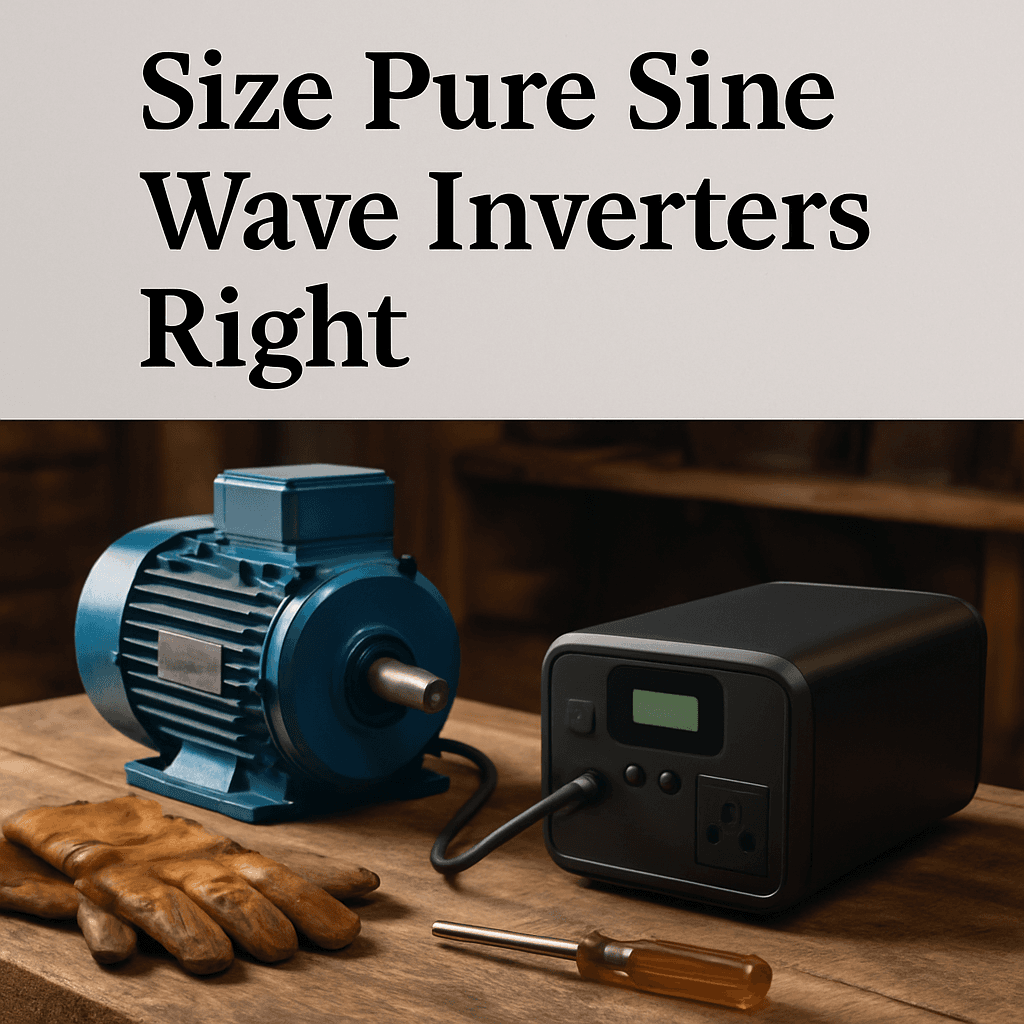
Size Pure Sine Wave Inverters Right: Use the 3-4x Surge Rule
Size a pure sine wave inverter to your highest continuous load, then confirm its surge rating covers at least 3-4 times the running watts of your largest motor or compressor — that surge headroom, not the continuous rating, is where most undersized setups actually fail. A pure sine wave inverter converts DC battery power into smooth, grid-quality AC electricity, matching the waveform your home's utility power already delivers. Here's when you actually need one, and how to size it correctly.
What a Pure Sine Wave Inverter Actually Does
A sine wave is a smooth, single-frequency signal with no distortion riding on top of it. Every inverter builds AC power from a DC battery using switching electronics, and the quality of those components determines how close the output gets to a true sine wave. Cheaper designs approximate the curve with steps or flat sections — these are called modified (or stepped/square) wave inverters. Better designs filter the output into something close to what your utility company actually sends into your wall outlets.
A modified wave inverter costs less and works fine for tolerant loads — incandescent bulbs, simple resistive heaters, basic power tools without variable-speed controls. It's the sensitive loads where the difference matters: laptops, medical equipment, audio gear, variable-speed motors, and most modern electronics with microprocessor controls can run poorly, buzz audibly, run hot, or shut down unexpectedly on a distorted waveform.
Do You Actually Need Pure Sine Wave?
- You need it for: CPAP machines and other medical equipment, laptops and sensitive electronics, audio equipment, variable-speed motors (modern fridge compressors, some power tools).
- You can usually skip it for: incandescent lighting, basic resistive space heaters, simple corded power tools without electronic speed control.
- Warning signs you're on the wrong type: audible buzzing from speakers or transformers, motors running hotter or louder than normal, chargers refusing to charge, or electronics shutting down unexpectedly under load.
Nearly every modern power station already uses a pure sine wave inverter internally, so this distinction matters most when you're buying a standalone inverter for a DIY solar or van life electrical setup — see our power station ports explained guide if you're trying to understand what your unit's built-in inverter already handles.
How to Size One Correctly
Sizing an inverter wrong in either direction causes real problems — undersized means nuisance trips or a motor that won't start; oversized means paying for capacity and idle draw you don't need. Work through this in order:
- List every device you'll run simultaneously, noting both continuous watts and startup (surge) watts for anything with a motor or compressor.
- Add up continuous wattage across everything running at once, then separately identify your single highest surge requirement.
- Pick a continuous rating comfortably above your total load, and confirm the surge rating covers your biggest startup spike — a motor-driven appliance commonly needs 3-4 times its running wattage just to start. If the manufacturer doesn't list a surge spec for a device, multiplying its running watts by 3-4 is a reasonable estimate.
- Match system voltage (12V, 24V, or 48V) to your battery bank, and confirm wire gauge and fuse sizing match the inverter's maximum current draw.
- Check runtime against your battery capacity using our power station sizing guide before committing to a purchase.
Before buying, also check: THD (total harmonic distortion) rating, real-world efficiency at your typical load rather than just the peak-efficiency number on the spec sheet, cooling method (fan vs. passive), and warranty length. Quality pure sine wave inverters typically run 85-95% efficient; cheaper designs can measurably underperform that range, especially at low load.
Typical Sizing by Use Case
- RV and van life: 1,000-3,000W continuous typically covers a fridge, microwave, and outlets — see our van life power setup guide for the full electrical system, not just the inverter.
- Camping and portable power: 300-1,000W handles phones, lights, and small coolers.
- Home backup for routers and medical equipment: 300-600W is often enough, but check device-specific surge needs — this matters most for CPAP machines and oxygen concentrators.
- Solar off-grid setups: size to your largest combined load, often 2,000W or more for a cabin running a mini-split and appliances together — see our off-grid cabin power guide and our mini-split power guide for a worked example of sizing against a real inductive load.
Certification: UL 2743 vs. UL 9540 Aren't Interchangeable
This trips up more buyers than it should. UL 2743 covers portable power packs (the category nearly every consumer power station falls into) and caps aggregate lithium-ion capacity at 20kWh — above that threshold, or for any unit permanently wired into your home's electrical system, the correct certification is ANSI/CAN/UL 9540, the standard for stationary energy storage systems, often referenced alongside UL 9540A thermal runaway testing and NFPA 855 installation codes. A portable power pack certified under UL 2743 isn't automatically rated for a permanent home backup installation — per UL's own guidance on this exact question, don't repurpose a high-capacity portable unit as a permanent installation without verifying the correct listing first.
That UL guidance also addresses a newer term worth knowing: TS-800 is a CSA large-scale fire-testing procedure for energy storage systems. As of UL's most recent guidance, it is not yet a consensus standard, and a TS-800 report isn't required for safety certification or for compliance with any model installation code in North America — useful context if you see it referenced in a product listing and aren't sure how much weight to give it.
Basic Safety Checks Before Powering Anything Up
- Mount the inverter in a ventilated space away from heat sources and moisture.
- Use fuses and wire gauges rated for the inverter's maximum current draw.
- Keep the clearance and separation distances recommended in the unit's installation guidance.
- Call a licensed electrician for any permanent home backup wiring or transfer switch installation — see our portable power station safety guide for the broader safety fundamentals.
Troubleshooting Common Problems
- Overheating or thermal shutdown — check for blocked vents, high ambient temperature, or a load exceeding the continuous rating.
- Frequent trips — verify battery voltage is within range and that no single device is drawing more than its rated surge.
- Buzzing or humming — inspect cable connections for looseness, and confirm the load is actually sine-wave sensitive rather than a loose-connection issue.
- Low or unstable output voltage — check battery state of charge first; a depleted bank often causes voltage sag before the inverter itself is at fault.
Frequently Asked Questions
What are the downsides of using a pure sine wave inverter?
Pure sine wave inverters cost more upfront than modified wave units of the same power rating and tend to be bulkier due to added filtering components. Efficiency also varies enough between models that it's worth checking a unit's real-world efficiency at your typical load, not just its peak-efficiency spec.
Do I really need a pure sine wave inverter?
You need one if you're running sensitive electronics, medical devices, or motor-driven appliances like compressors and pumps, since these can run poorly, noisily, or not at all on a distorted waveform. Simple resistive loads like heaters or incandescent lighting typically work fine on a modified wave inverter.
What's the difference between an inverter and a pure sine wave inverter?
An inverter is any device that converts DC battery power into AC power, but the output waveform quality varies widely between models. A pure sine wave inverter is specifically built to produce a clean, low-distortion waveform matching utility power, while modified or square wave inverters produce a cruder approximation that introduces harmonics.
How much surge headroom do I actually need above running watts?
As a rule of thumb, size surge capacity to 3-4 times the running wattage of your largest motor or compressor if the manufacturer doesn't specify an exact surge rating — this covers the brief, high-current spike most motors draw at startup, which the continuous wattage rating alone doesn't account for.
Related Articles
 Solar & Technical Guides
Amps to Watts: The Conversion Formula Explained (With Real Examples)
To convert amps to watts, multiply current by voltage. Here's the formula, worked examples at common voltages, and when power factor changes the math.
 Solar & Technical Guides
How Loud Are Portable Power Stations? Real Noise Levels Explained
"Silent" marketing claims are only half true — most power stations have a cooling fan that kicks in under load. Here's what they actually sound like in decibels.
 Solar & Technical Guides
How Extreme Heat Affects Your Power Station (And What Desert Climates Need to Know)
Sustained heat above 113°F can cut a power station's usable lifespan roughly in half. Here's the real degradation math and what to actually do about it in hot climates.