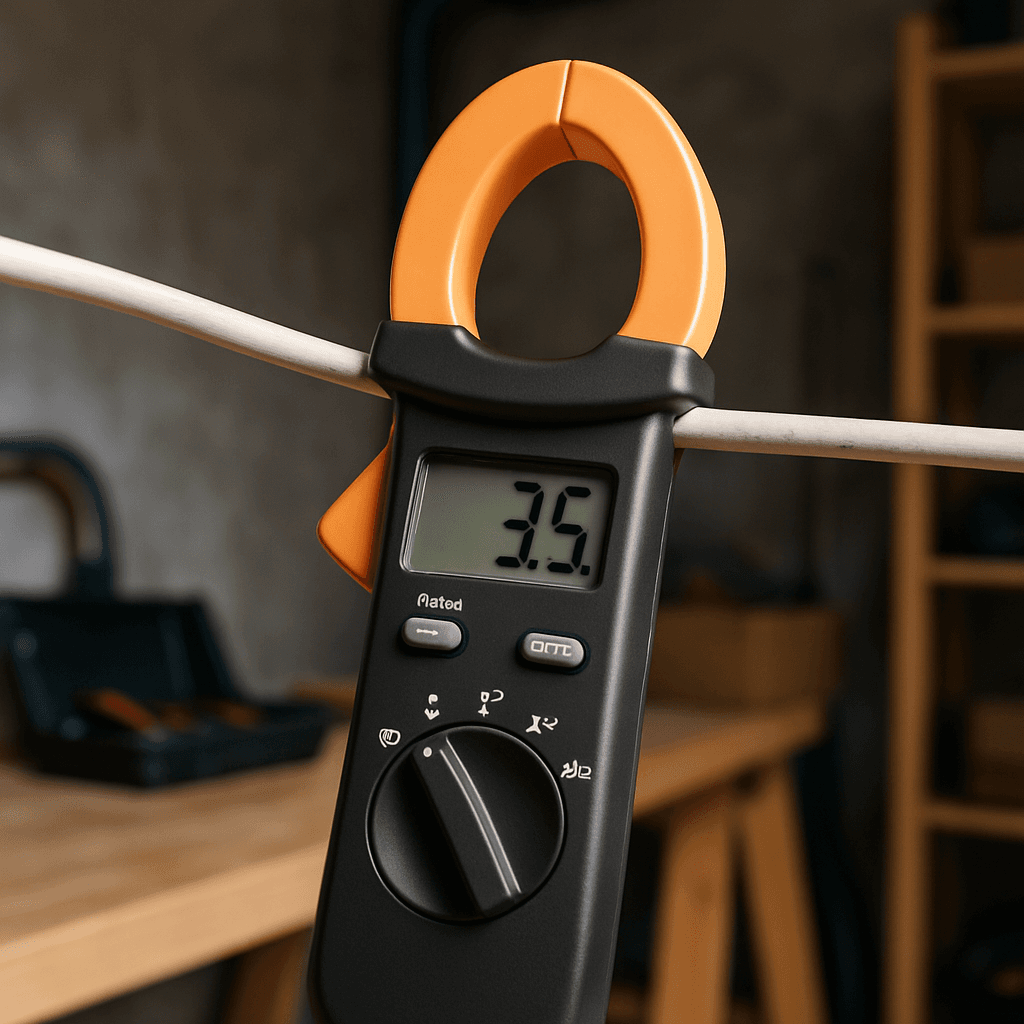
Amps to Watts: The Conversion Formula Explained (With Real Examples)
To convert amps to watts, multiply current by voltage: watts = amps × volts. On a standard 120V US household outlet, 10 amps works out to 1,200 watts (10 × 120). The same math applies to a 12V car or power station port — 8 amps there is only 96 watts (8 × 12), since the lower voltage means far less power for the same current. Here's the full formula, worked examples at the voltages you'll actually run into, and the one exception that trips people up.
The Formula
Once you know two of the three values — amps, volts, or watts — the third is always one step away:
- Watts = Amps × Volts
- Amps = Watts ÷ Volts
The only way to get this wrong is using the wrong voltage for the circuit or device you're actually working with — assuming 120V when a circuit is actually 240V (common for large appliances) throws off the whole calculation even though the math itself is correct. Confirm your voltage first, then multiply.
Worked Examples at Common Voltages
- 12V (car, marine, power station DC port): 8A × 12V = 96W — typical for a phone charger or small inverter load.
- 120V (standard US household outlet): 10A × 120V = 1,200W — a common ceiling for a single receptacle.
- Reverse direction at 120V: a 1,500W space heater or microwave draws 12.5A (1,500 ÷ 120), which is exactly why these appliances often trip a breaker when paired with something else on the same circuit.
- 240V (large appliances): the same 1,500W load at 240V draws only 6.25A (1,500 ÷ 240) — half the current of the 120V version, because voltage and amperage move in opposite directions for a fixed wattage. Lower amps at 240V doesn't mean lower power; it means the same power delivered more efficiently through the wire.
Our watts to amps calculator handles this conversion instantly in either direction if you'd rather skip the manual math, and our runtime calculator turns a converted wattage into an actual estimated runtime once you know your power station's capacity.
Why Power Factor Changes the Math for Some Devices
The simple formula above is exact for resistive loads — heaters, incandescent lighting, anything that just converts electricity straight to heat or light. It's an approximation for devices with a motor, compressor, or transformer (fridges, power tools, AC units), which draw some reactive current alongside the real power they use. For these loads, the more accurate formula is watts = amps × volts × power factor, where power factor is a number between 0 and 1. The Department of Energy's guidance on power factor confirms this effect mainly shows up in motor-driven and industrial equipment — for ordinary household resistive loads, the simple formula still holds without adjustment.
In practice, this means a motor-driven device can pull noticeably more current than the simple watts-to-amps math predicts for its stated power draw. If a device's real-world amp reading runs higher than your calculation, power factor — not a bad calculation — is usually why.
Circuit Ratings: The Other Half of the Picture
Converting amps to watts only tells you the load — it doesn't tell you whether a circuit can safely handle it. OSHA's wiring design standard governs circuit and receptacle ratings, and the standard practice is to keep continuous loads at no more than 80% of a circuit's rated capacity — meaning a 15A circuit should carry at most about 12A continuously, and a 20A circuit about 16A. A few common pairings: 15A circuits serve general household outlets, 20A circuits handle kitchens and workshops, and 30A circuits are reserved for dryers, RV hookups, and other larger dedicated equipment.
If you're unsure whether a circuit or breaker can handle a new load, a licensed electrician is the right call rather than a guess — the consequences of an overloaded circuit (tripped breakers at best, an overheated connection at worst) aren't worth the risk of assuming.
Don't Forget Startup Surge
The watts-to-amps formula describes running (continuous) power, not the momentary spike many motors and compressors draw when they first start — often two to three times their running wattage for a fraction of a second. This matters most when you're sizing a power station or generator against a device's converted wattage: a correctly converted running-watts number can still undersize your system if you don't also account for startup surge. See our running watts vs. surge watts guide for the full breakdown of why this distinction trips up so many first-time buyers.
Frequently Asked Questions
How many watts is 1 amp?
It depends entirely on voltage, since power equals current times voltage. At 120V, 1 amp equals 120 watts; at 12V, 1 amp equals only 12 watts — you always need the voltage to complete the conversion.
How many amps is 1,500 watts?
At 120V, a 1,500W device draws 12.5 amps (1,500 ÷ 120), which is why heaters and microwaves rated near that wattage often need their own circuit. At 240V, the same 1,500W load draws only 6.25 amps.
What is 20 amps in watts?
At 120V, 20 amps converts to 2,400 watts (20 × 120). At 240V, the same 20 amps converts to 4,800 watts, since power scales directly with voltage for a fixed current.
What is 30 amps in watts?
At 120V, 30 amps equals 3,600 watts — a common rating for RV and dedicated appliance circuits. At 240V, 30 amps is typical for larger loads like electric dryers or well pumps.
Related Articles
 Solar & Technical Guides
Size Pure Sine Wave Inverters Right: Use the 3-4x Surge Rule
A pure sine wave inverter needs headroom for startup surge, not just running watts. Here's how to size one correctly, and when you can skip it entirely.
 Solar & Technical Guides
How Loud Are Portable Power Stations? Real Noise Levels Explained
"Silent" marketing claims are only half true — most power stations have a cooling fan that kicks in under load. Here's what they actually sound like in decibels.
 Solar & Technical Guides
How Extreme Heat Affects Your Power Station (And What Desert Climates Need to Know)
Sustained heat above 113°F can cut a power station's usable lifespan roughly in half. Here's the real degradation math and what to actually do about it in hot climates.