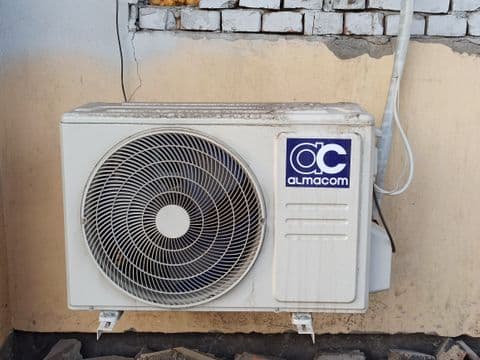
How to Power a Mini Split AC Unit During an Outage
Realistically, only for a few hours at a time. A small mini split draws 700–900W running (up to 1,800W+ on startup), so even a large 2,048Wh power station provides roughly 2.5 hours of cooling, not all-day operation. Mini split (ductless) AC units are more power-efficient than central air or window units, which makes them the most realistic AC option to consider running on battery backup during an outage — though it's still a demanding load that requires careful sizing.
Mini Split Power Draw
| Mini Split Size | Running Watts | Startup Surge |
|---|---|---|
| Small (9,000 BTU) | 700-900W | Up to 1,800W+ momentarily |
| Medium (12,000 BTU) | 900-1,200W | Up to 2,200W+ momentarily |
| Large (18,000 BTU) | 1,300-1,800W | Up to 3,000W+ momentarily |
Like other compressor-driven equipment (mini fridges, sump pumps), the startup surge is the critical spec — your power station's peak/surge output rating needs to comfortably exceed this number, or the unit may fail to start even with enough total capacity.
Realistic Runtime
| Power Station Capacity | Small Mini Split (800W avg) Runtime |
|---|---|
| 2,048Wh | ~2.5 hours |
| 6,144Wh (expanded) | ~7.5 hours |
Mini splits cycle on and off similar to a fridge once the room reaches target temperature, so actual runtime is often longer than a pure continuous-load calculation suggests — but budget conservatively, since compressor cycling behavior varies by unit and outdoor temperature.
Recommended Setup
For any realistic mini split backup capability, you'll want a large-capacity unit with high continuous/surge output — a Jackery Explorer 2000 Plus (3,000W output, expandable to 12kWh) or EcoFlow Delta 2 Max (expandable to 6,144Wh) are the more realistic options in our lineup for this specific, demanding use case.
Pure Sine Wave Is Non-Negotiable Here
Mini split compressors are sensitive to power quality in a way simple resistive loads (lights, heaters) aren't. Always confirm your power station outputs a pure sine wave, not a modified sine wave — running a compressor-driven AC unit on modified sine wave power can cause it to run hotter, louder, or fail to start reliably, and can shorten the compressor's lifespan over repeated use. Nearly all modern power stations from mainstream brands are pure sine wave, but it's worth confirming on the spec sheet rather than assuming, especially with budget or lesser-known brands.
Managing Expectations
Running a mini split on battery power for an extended multi-day outage isn't realistic without a very large expandable system — this use case works best as short-term relief (a few hours during the hottest part of the day) rather than continuous multi-day cooling. Pair with passive cooling strategies (closed blinds, minimizing heat-generating appliance use) to stretch your runtime further.
Frequently Asked Questions
Can a portable power station run a mini split AC unit all day?
Realistically, only with a very large expanded system (6,000Wh+), and even then likely for less than a full day of continuous operation. For most households, a few hours of relief during peak heat is a more realistic expectation than all-day cooling.
Is a mini split more power-efficient than a window AC unit?
Generally yes — mini splits are typically more energy-efficient per BTU of cooling than standard window units, which is part of why they're the more realistic AC option to consider for battery backup among common home AC types.
Related Articles
 Use Cases
Can a Power Station Work as a UPS for Your Computer or Router?
Many power stations offer a UPS or EPS mode that switches to battery power during an outage. Here's how it actually works, and where it falls short of a dedicated UPS.
 Use Cases
Portable Power Stations for Van Life: Complete Setup Guide
Everything you need to know to build a reliable power system for van life or full-time RV living, from sizing to solar to daily habits that make it last.
 Use Cases
Using a Power Station to Charge an Electric Bike
E-bike charging away from home outlets is easier than you'd think with the right power station. Here's how to size one for your specific e-bike battery.