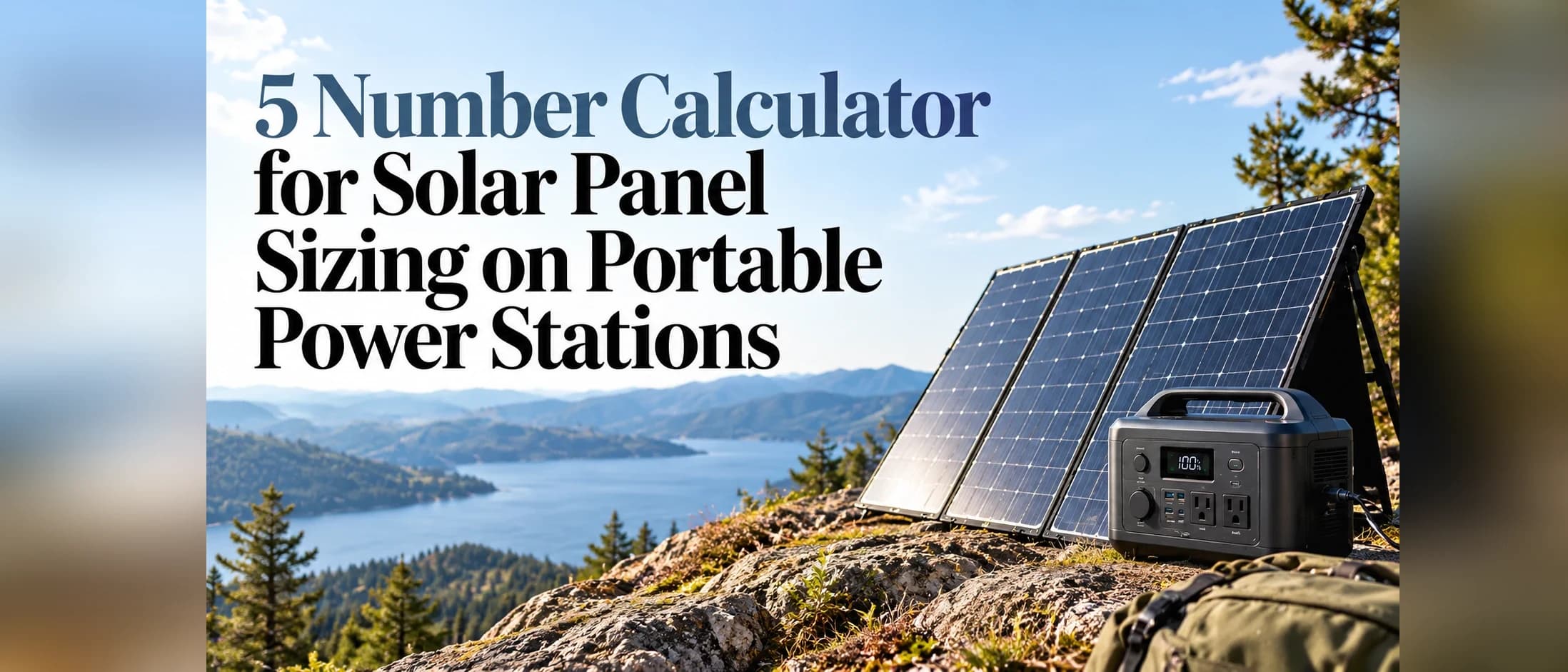
5 Number Calculator for Solar Panel Sizing on Portable Power Stations
The short answer: panel watts = daily watt-hours ÷ (peak sun hours × 0.75). For a camper using 1,010Wh a day with 4 peak sun hours, that is about 337W, so buy a 400W foldable array. Then check one more number: the station's maximum solar input, because the array can't push more than that into the battery. This formula predicted recharge times within about 7% of independent tests on the Jackery Explorer 2000 v2 and 2000 Plus, as shown below.
The 5 Numbers
| # | Number | How to get it | Example |
|---|---|---|---|
| 1 | Daily watt-hours | Watts × hours for each device, added up | 1,010Wh |
| 2 | Peak sun hours | Use a conservative figure for your weakest season: 3 to 5 | 4 hours |
| 3 | Loss factor | 0.75 for panels, cables, heat, and conversion losses | 0.75 |
| 4 | Panel watts needed | #1 ÷ (#2 × #3) | 337W |
| 5 | Station solar input limit | From the spec sheet or label | 400W+ |
Round the answer up to the next common size (100W, 200W, 400W) for cloudy-day margin. Our wattage sizing guide shows how to get number 1, and our runtime calculator can total your devices.
Number 2: Peak Sun Hours, Not Daylight Hours
A peak sun hour is one hour of sunlight at the intensity panels are rated for, so a 7-hour winter day may give only 2 to 3. Most of the continental US averages roughly 4 to 6 peak sun hours a day over the year, and the US Department of Energy notes that solar radiation varies with location and season. Size for the weakest season you will rely on, and treat summer as a bonus.
Number 3: Why 0.75?
A panel's rated wattage is a laboratory peak. Real output falls with heat (above the 77°F standard test temperature), dust, imperfect tilt, partial shade, cable length, and conversion losses in the station. A 0.75 planning factor covers those losses. It matches the 0.7 to 0.8 range in our solar recharge time guide, and the reality check below shows it holds up against tested hardware.
Reality Check Against Independent Tests
| Test | Formula: Wh ÷ (panel W × 0.75) | Measured |
|---|---|---|
| Jackery Explorer 2000 v2 (1,710Wh usable) on one 200W panel | about 11.4 hours | 10-12 hours in perfect sun (OutdoorGearLab) |
| Jackery Explorer 2000 Plus (1,678Wh usable) on one 100W panel | about 22.4 hours | about 21 hours (OutdoorGearLab) |
| Bluetti Elite 200 V2 (2,073.6Wh) on a 1,000W array | about 2.8 hours | about 2.4 hours under optimal sun (StorageReview) |
The formula is slightly conservative, which is the safe side. Those are best-case conditions, so expect longer on cloudy or short winter days.
Number 5: Your Station's Solar Input Limit
Every station caps what it accepts, in watts, volts, and amps. A bigger array won't charge faster than the cap, and the wrong voltage can trip protection or damage it. Maximum solar input of popular stations, checked against each brand's page on October 3, 2026:
| Power station | Max solar input |
|---|---|
| Jackery Explorer 2000 v2 | 400W (OutdoorGearLab) |
| Jackery Explorer 1000 v2 | 400W |
| EcoFlow DELTA 3 | 500W |
| Bluetti AC70 | 500W |
| Anker SOLIX C1000 (Gen 1) | 600W |
| Anker SOLIX C2000 Gen 2 | 800W |
| Bluetti Elite 200 V2 | 1,000W |
| EcoFlow DELTA 2 Max | 1,000W (two inputs, 500W each per StorageReview) |
| OUPES Mega 5 | 2,100W |
Also check the input voltage range and maximum current on the station's label or manual. Many stations simply limit excess wattage, but exceeding the voltage or current rating is where damage happens. Panel voltage rises in cold weather, so leave headroom below the maximum.
Worked Examples
- Weekend camper. Phone charging (10W × 3h = 30Wh), CPAP (40W × 8h = 320Wh), cooler (60W × 10h = 600Wh), and LED lights (15W × 4h = 60Wh) total 1,010Wh. At 4 sun hours: 1,010 ÷ (4 × 0.75) = 337W, so a 400W foldable array. That exactly meets the 400W limit of a Jackery 1000 v2 or 2000 v2. See our weekend camping power guide.
- Light-service food truck or cart. POS tablet 120Wh, task lighting 240Wh, small fridge 640Wh, phone charging 30Wh total 1,030Wh (from our food truck wattage guide). At 4 sun hours: 343W, so 400W. A parked truck is often shaded, so check the placement first.
- Home backup essentials. Refrigerator (150W × 8h = 1,200Wh), lights (40W × 6h = 240Wh), router (10W × 24h = 240Wh) total 1,680Wh. At 4 sun hours: 1,680 ÷ 3 = 560W, so two 300W rigid panels (600W). In winter at 3 sun hours it becomes 747W, so plan 800W. Confirm the station accepts it: the Elite 200 V2 and DELTA 2 Max both take 1,000W.
Array Configuration
- Series wiring adds voltage and keeps current the same; use it when current is your limit and you have voltage headroom.
- Parallel wiring adds current and keeps voltage the same; use it when voltage is the tighter limit.
- Connectors: MC4 is common on rigid panels; many stations use proprietary or Anderson-style ports, so confirm compatibility or budget for an adapter (OutdoorGearLab noted the Jackery 2000 v2 needs one for third-party panels).
- Shade on one panel in a series string can cut the whole string's output.
- Keep cable runs short and use the right gauge.
Details are in our guide on connecting multiple solar panels, and our watts to amps calculator converts panel specs. For brand-matched options, see best solar panels to pair with your power station and our power station and solar panel bundles.
Seasons and Location
Size for the weakest season. A system that recharges in July but not in December isn't sized correctly. Tilt a portable panel steeper in winter to catch the lower sun, and follow the sun through the day if you can. If you travel, size for the weakest location you expect to rely on. For cabins, see our off-grid cabin sizing guide.
Panel Types
Monocrystalline panels are the most efficient common type and dominate foldable panels for power stations, giving the most watts in the smallest, lightest package. Polycrystalline panels are generally less efficient and appear mostly in lower-cost rigid panels. Thin-film panels are the least efficient per square foot but are flexible and light, useful on curved surfaces.
Matching Battery and Array
Size the array to replace what you use in a day, not to fill the whole battery. With a 2,000Wh battery and a 1,000Wh daily draw, the array only has to return about 1,000Wh. Size battery and solar separately and leave headroom in the station's solar input, so adding one more panel later covers growth.
Disclosure: WattStation HQ may earn a commission if you purchase through links on this page, at no extra cost to you. This does not affect our rankings — see our editorial policy.
Frequently Asked Questions
What size solar panel do I need for my power station?
Divide your daily watt-hours by peak sun hours times 0.75. A 1,010Wh day at 4 sun hours needs about 337W, so a 400W array, provided your station accepts at least that much solar input.
Can I use panels larger than my station's rated solar input?
Often the station just limits the extra wattage, but it depends on the brand, so check the manual. Never exceed the maximum voltage or current. Beyond the input cap, extra panel watts don't charge faster.
How long does it take to recharge a power station with solar?
Roughly battery Wh ÷ (panel watts × 0.75). A 1,710Wh Jackery 2000 v2 on one 200W panel takes about 11 hours of good sun, matching OutdoorGearLab's 10 to 12 hours.
Should I wire solar panels in series or parallel?
Series adds voltage, parallel adds current. Choose based on which limit your station's input is closer to, and verify the combined voltage and current stay inside the rating before connecting. The simplest route is a brand-designed multi-panel kit.
What type of solar panel is best for a portable power station?
Monocrystalline foldable panels, for their efficiency and portability. Rigid panels cost less per watt and suit fixed installations such as cabins.
Power Stations We'd Look At for This
Picked from our reviews for this scenario. Prices change often, so check the current price before you buy.
This page contains affiliate links. See our affiliate disclosure.
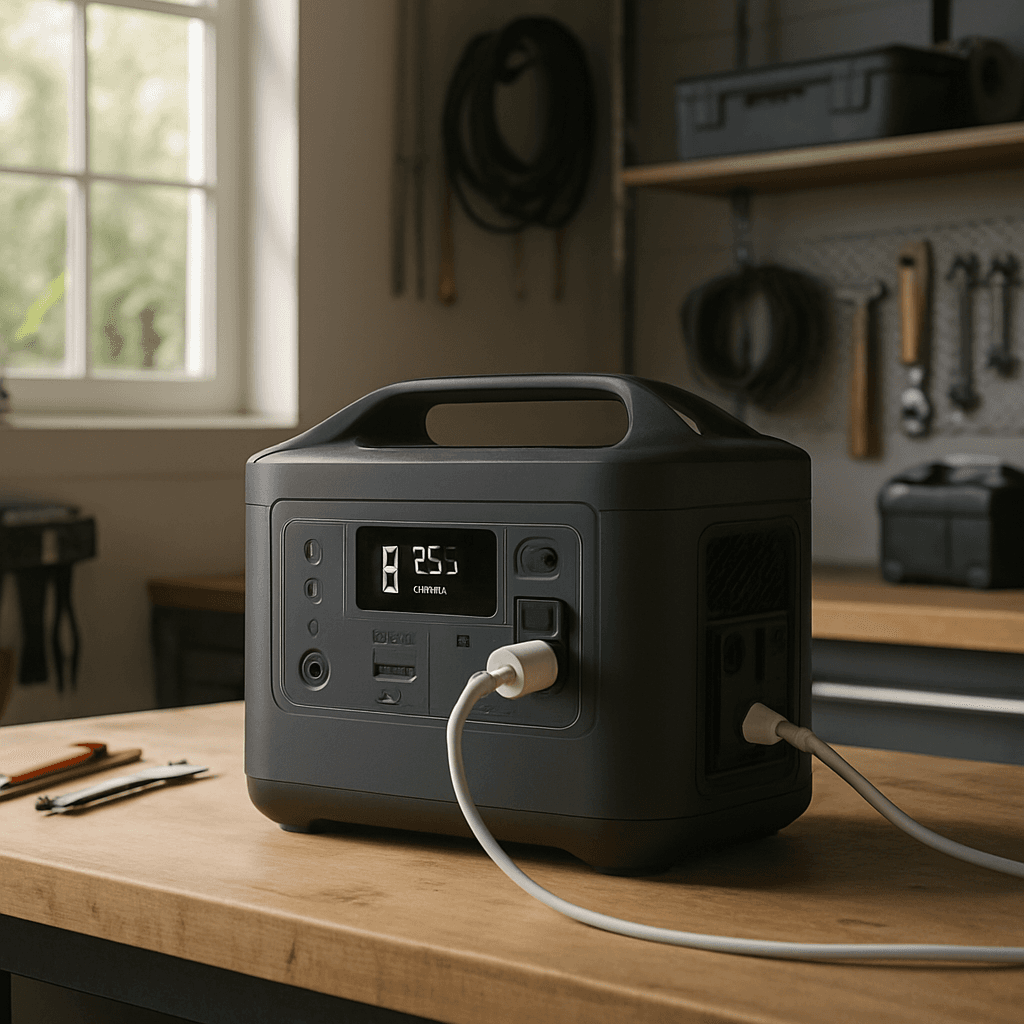
Bluetti Elite 200 V2
4.5/5 in our review
Jackery Explorer 2000 v2
4.5/5 in our review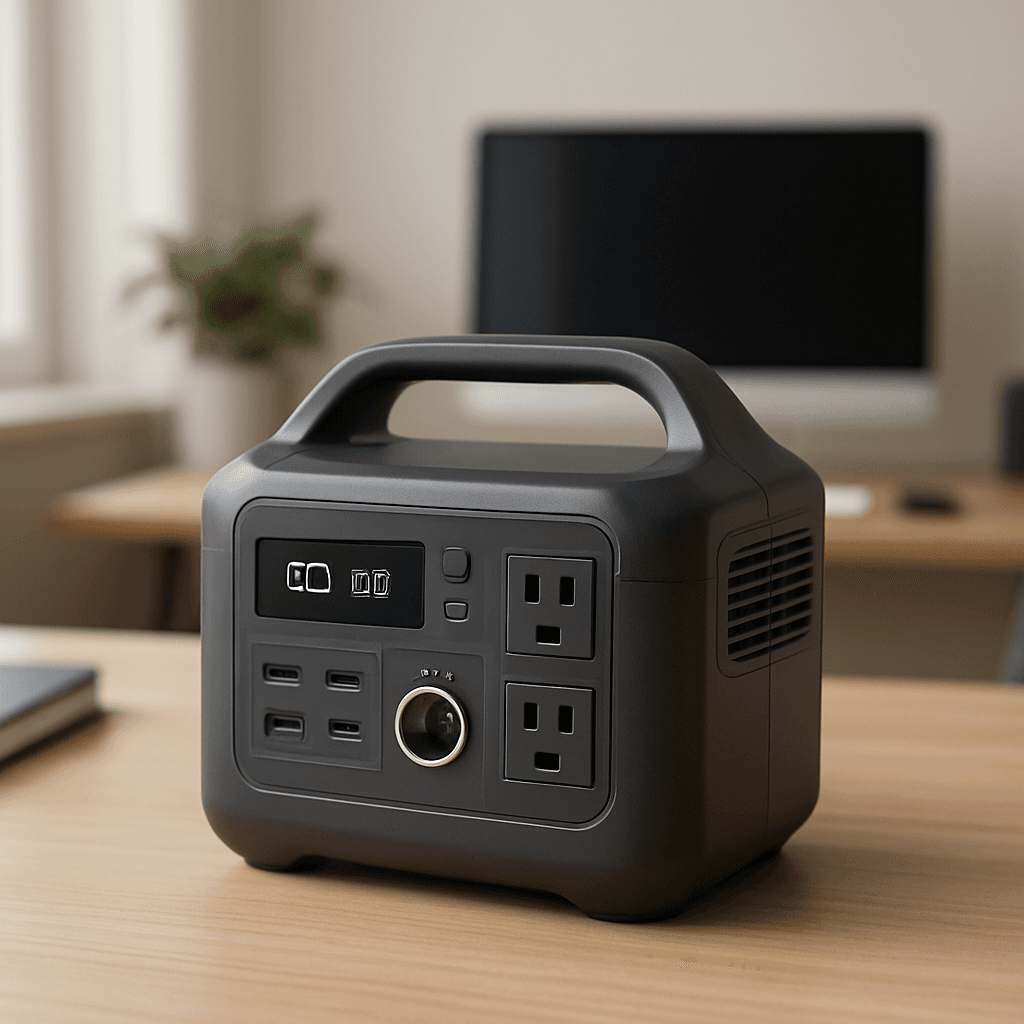
EcoFlow Delta 2 Max
4.5/5 in our review
Bluetti AC70
4.3/5 in our reviewRelated Articles
 Solar & Technical Guides
Calculate Watt Hours Fast: Turn a 20,000mAh Power Bank into 74 Wh
Watt-hours = amp-hours × volts. Here's how to convert mAh to Wh, size a battery from your device list, and why the number on the label is never what you actually get.
 Solar & Technical Guides
Size Pure Sine Wave Inverters Right: Use the 3-4x Surge Rule
A pure sine wave inverter needs headroom for startup surge, not just running watts. Here's how to size one correctly, and when you can skip it entirely.
 Solar & Technical Guides
Amps to Watts: The Conversion Formula Explained (With Real Examples)
To convert amps to watts, multiply current by voltage. Here's the formula, worked examples at common voltages, and when power factor changes the math.