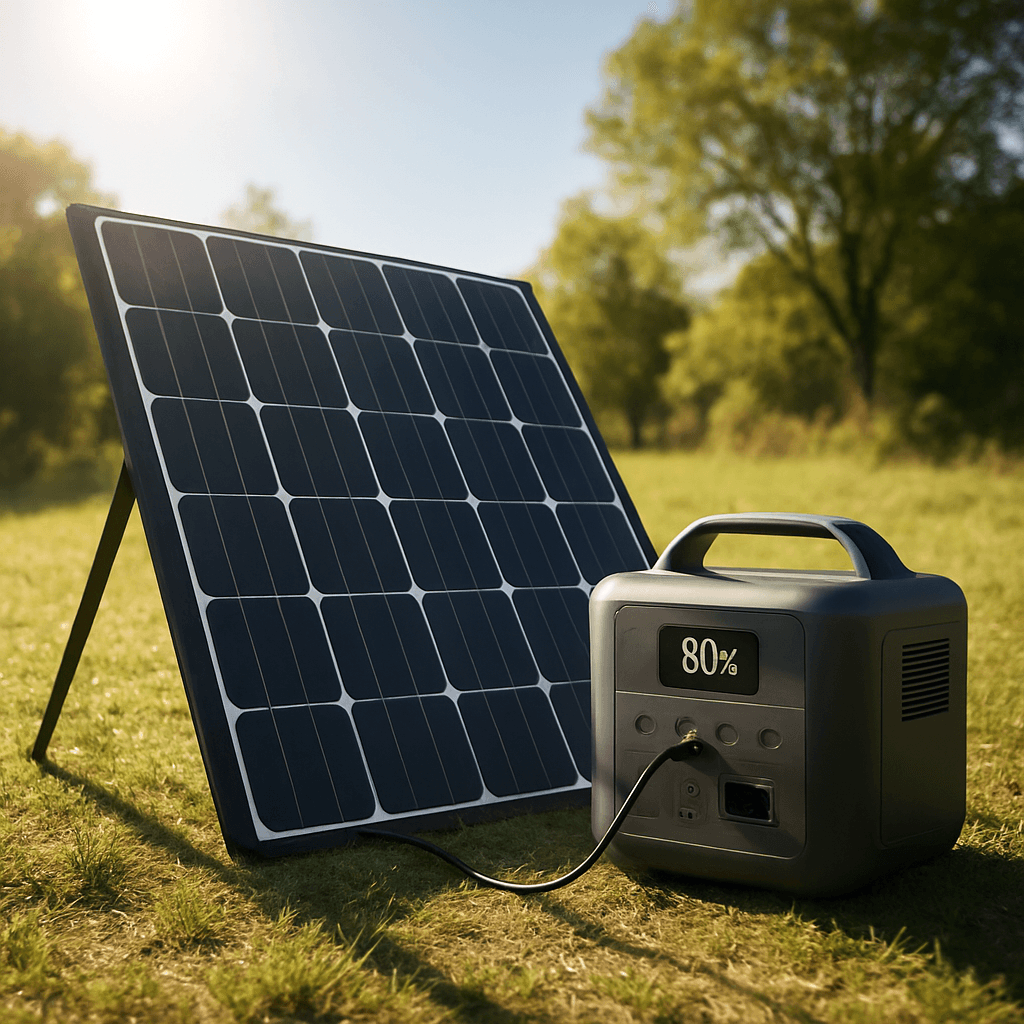
How to Calculate Solar Recharge Time for Your Power Station
Recharge time (hours) ≈ power station capacity (Wh) ÷ (panel wattage × 0.7–0.8 efficiency factor). For example, a 1,070Wh unit with a 200W panel takes about 7 hours of good, direct sunlight. Solar recharge time is one of the most commonly miscalculated numbers in power station planning — manufacturers often quote best-case scenarios that don't reflect typical real-world conditions. Here's how to calculate a realistic estimate.
The Basic Formula
Recharge time (hours) ≈ Power station capacity (Wh) ÷ (Panel wattage × efficiency factor)
The efficiency factor accounts for real-world losses — a reasonable estimate is 0.7-0.8 (70-80%) under good conditions, accounting for panel angle imperfections, minor cloud cover, and conversion losses.
Worked Example
For a 1,070Wh power station (Jackery Explorer 1000 v2) with a 200W solar panel:
1,070Wh ÷ (200W × 0.75) = 1,070 ÷ 150 ≈ 7.1 hours of good sun
This assumes strong, mostly direct sunlight — realistic for a clear day with good panel positioning, but longer under partial cloud cover or a suboptimal angle.
Peak Sun Hours Matter More Than Total Daylight
"Peak sun hours" refers to hours of sunlight intense enough to generate near-rated panel output, not just total daylight hours — most of the continental US gets roughly 4-6 peak sun hours per day depending on season and latitude, meaning your panel isn't charging at full rated wattage for the entire time it's light outside.
Factors That Slow Down Real-World Charging
- Cloud cover — even partial cloud cover can cut output by 50% or more
- Poor panel angle — a flat panel vs. one angled directly at the sun can differ significantly in output
- Panel shading — even partial shading on one section of a panel can disproportionately reduce total output
- Seasonal and latitude variation — winter and higher-latitude locations get fewer peak sun hours than summer or equatorial locations
Multi-Panel Arrays Scale Linearly (Mostly)
If you're using multiple panels wired together (see our connecting multiple panels guide), total wattage adds up roughly linearly, letting you plug the combined wattage into the same formula — assuming your power station's max solar input rating can actually accept that combined wattage.
Why the Efficiency Factor Varies So Much
The 0.7-0.8 range used in the formula is a reasonable general estimate, but real installations can fall meaningfully outside it in either direction. A well-angled panel in direct, unobstructed sun on a cool day can approach 0.85-0.9 effective efficiency, while a flat-mounted panel with a suboptimal angle, some shading, or hot ambient temperatures (panel efficiency drops somewhat as the panel itself heats up) can fall to 0.5-0.6. If your actual recharge times are consistently running long even accounting for the standard efficiency factor, check panel angle and shading first — they're the most common culprits and the easiest to fix.
Recharging While Also Powering Devices
The formula above assumes all solar input goes toward recharging the battery, but if you're simultaneously running devices off the power station while it charges, the effective recharge rate drops — solar input first covers whatever you're actively drawing, with only the surplus going toward the battery itself. During an extended outage where you're powering a fridge or medical equipment around the clock, factor in that your realistic recharge time will run longer than the formula suggests unless your panel wattage comfortably exceeds your simultaneous power draw.
Frequently Asked Questions
Why is my actual solar recharge time longer than the manufacturer's stated time?
Manufacturers often quote best-case, full-sun, ideal-angle scenarios — real-world conditions (partial cloud cover, imperfect angle, seasonal variation) typically extend recharge time meaningfully beyond the marketing number. Use the 0.7-0.8 efficiency factor for a more realistic estimate.
Does solar charging work on a cloudy day at all?
Yes, but at significantly reduced output — often 10-25% of rated panel wattage under heavy cloud cover. Solar charging still works, just much more slowly, so don't rely on a cloudy-day estimate matching your clear-day calculation.
Related Articles
 Solar & Technical Guides
How Extreme Heat Affects Your Power Station (And What Desert Climates Need to Know)
Sustained heat above 113°F can cut a power station's usable lifespan roughly in half. Here's the real degradation math and what to actually do about it in hot climates.
 Solar & Technical Guides
Do Portable Power Stations Qualify for Tax Credits or Rebates?
Most portable power stations don't qualify for the federal battery tax credit — here's why, which setups actually might, and where state and utility rebates can still help.
 Solar & Technical Guides
How Much Does It Actually Cost to Run a Power Station vs. Grid Electricity?
A power station doesn't generate cheaper electricity — it stores grid or solar power for later. Here's the honest math on what that actually costs you per kWh.