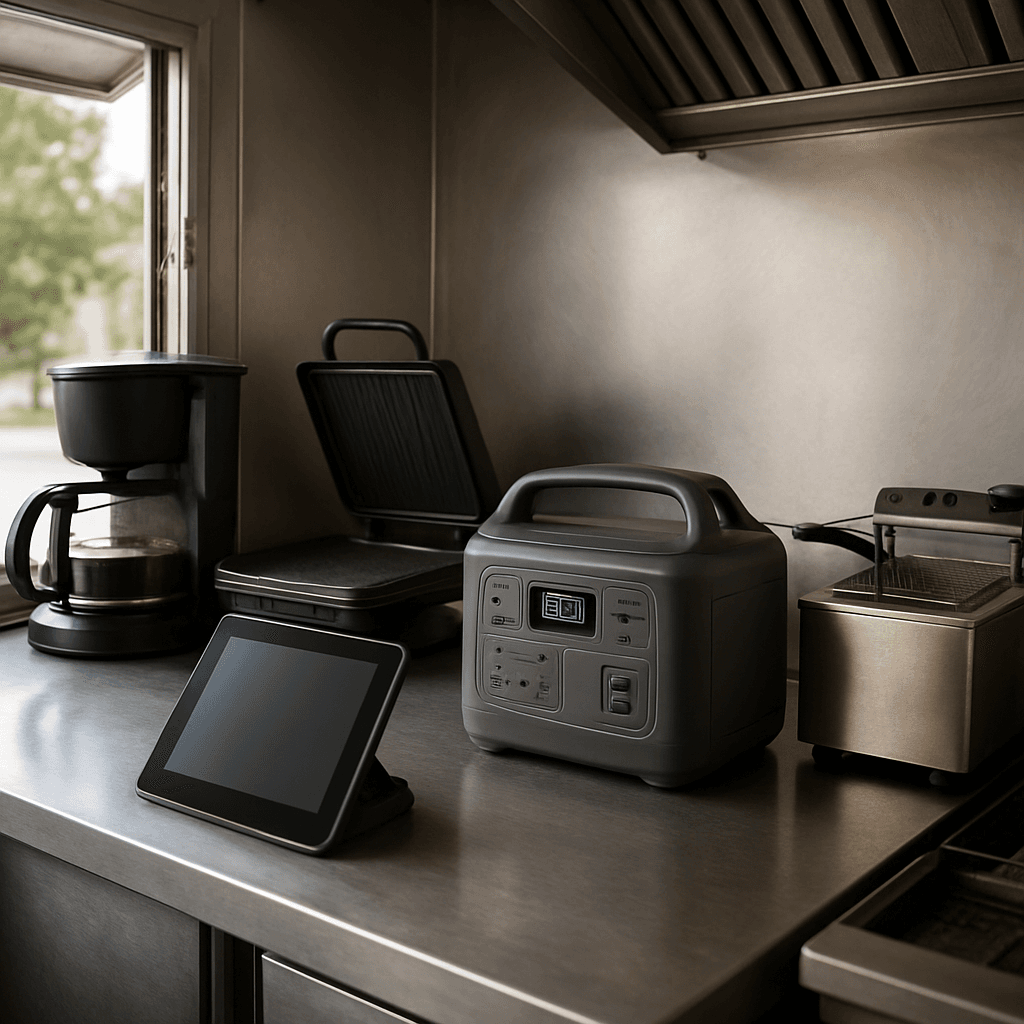
Using a Power Station for a Food Truck: Wattage Guide
Most light-service food trucks (POS, lighting, a small fridge, phone charging) need 800-1,500Wh per service day — but the only way to know your real number is an honest wattage inventory of your actual equipment, not a guess. Here's how to do it correctly.
Step 1: List Every Device and Its Wattage
Check the label or spec sheet on each piece of equipment for its running wattage (not just amps — multiply amps × 120V if only amps is listed). Common food truck/vendor equipment:
| Equipment | Typical Running Watts |
|---|---|
| POS system/tablet | 10-20W |
| String/task lighting | 20-60W |
| Small fridge or cooler | 60-150W (average, with cycling) |
| Blender (intermittent use) | 300-1,000W |
| Small induction burner | 1,000-1,800W |
| Phone/tablet charging | 10-20W each |
Step 2: Separate "Always On" From "Occasional Use"
Your continuous, always-on loads (POS, lighting, refrigeration) determine your baseline capacity need over a service day. Occasional-use, higher-draw equipment (blenders, warming equipment) determines your required continuous output rating, even if you don't run them constantly — your power station needs to handle the peak moment when multiple things run at once.
Step 3: Calculate Total Daily Watt-Hours
Multiply each device's wattage by its hours of use during a service day, then sum the total — this gives you your target capacity. A typical light-service setup (POS, lighting, small fridge, occasional phone charging) runs 800-1,500Wh over a full service day; see our full best power station for food trucks comparison for model recommendations once you have your number.
Step 4: Add a Safety Margin
Add 20-30% above your calculated need to account for colder weather (which reduces battery efficiency), unexpectedly long service days, or equipment you forgot to include in your initial inventory.
What NOT to Run on a Power Station
Heavy cooking equipment — griddles, deep fryers, large ovens — routinely draws 1,500-3,000W+ continuously, which exceeds what most portable power stations can sustain for a full service day without an oversized, expensive system. Keep primary cooking equipment on propane or a dedicated generator, and reserve your power station for lighting, POS, refrigeration, and smaller appliances.
The same sizing approach applies to other vendor and commercial-adjacent setups — see our guides on construction site power stations and power stations for music festivals and events if either is closer to your use case.
A Worked Example: Full Service Day Calculation
Putting the steps together for a typical light-service cart:
| Equipment | Watts | Hours | Watt-Hours |
|---|---|---|---|
| POS tablet | 15W | 8h | 120Wh |
| Task lighting | 40W | 6h | 240Wh |
| Small fridge (cycling avg) | 80W | 8h | 640Wh |
| Phone charging | 15W | 2h | 30Wh |
| Subtotal | 1,030Wh | ||
| +25% safety margin | ~1,290Wh |
That lands squarely in the 800-1,500Wh range most light-service trucks need — a unit like the EcoFlow Delta 2 Max covers this with room to spare and fast recharge overnight. Run the same table with your own equipment's actual labeled wattage for a number specific to your setup.
Generator vs. Power Station for Food Trucks Specifically
Beyond the noise and emissions difference covered elsewhere on this site, food trucks have a specific consideration: customers standing at your service window. A generator's noise and exhaust fumes sit right where people are ordering food, which is a real customer-experience cost beyond the practical logistics — a power station removes that entirely for everything except heavy cooking equipment. See our power station vs. gas generator comparison for the fuller general tradeoff.
Frequently Asked Questions
How do I find the wattage of equipment that only lists amps?
Multiply the amp rating by your outlet voltage (120V for standard US outlets) to get watts — for example, a device rated at 5A draws approximately 600W (5 × 120). Our watts to amps calculator does this conversion instantly if you'd rather skip the manual math.
Can I run my whole food truck on battery power alone?
For lighting, POS, refrigeration, and small appliances, yes with proper sizing. For primary cooking equipment, most food trucks still rely on propane or a generator, since the wattage requirements exceed what's practical for battery power alone.
Related Articles
 Use Cases
Can a Power Station Work as a UPS for Your Computer or Router?
Many power stations offer a UPS or EPS mode that switches to battery power during an outage. Here's how it actually works, and where it falls short of a dedicated UPS.
 Use Cases
Portable Power Stations for Van Life: Complete Setup Guide
Everything you need to know to build a reliable power system for van life or full-time RV living, from sizing to solar to daily habits that make it last.
 Use Cases
Using a Power Station to Charge an Electric Bike
E-bike charging away from home outlets is easier than you'd think with the right power station. Here's how to size one for your specific e-bike battery.