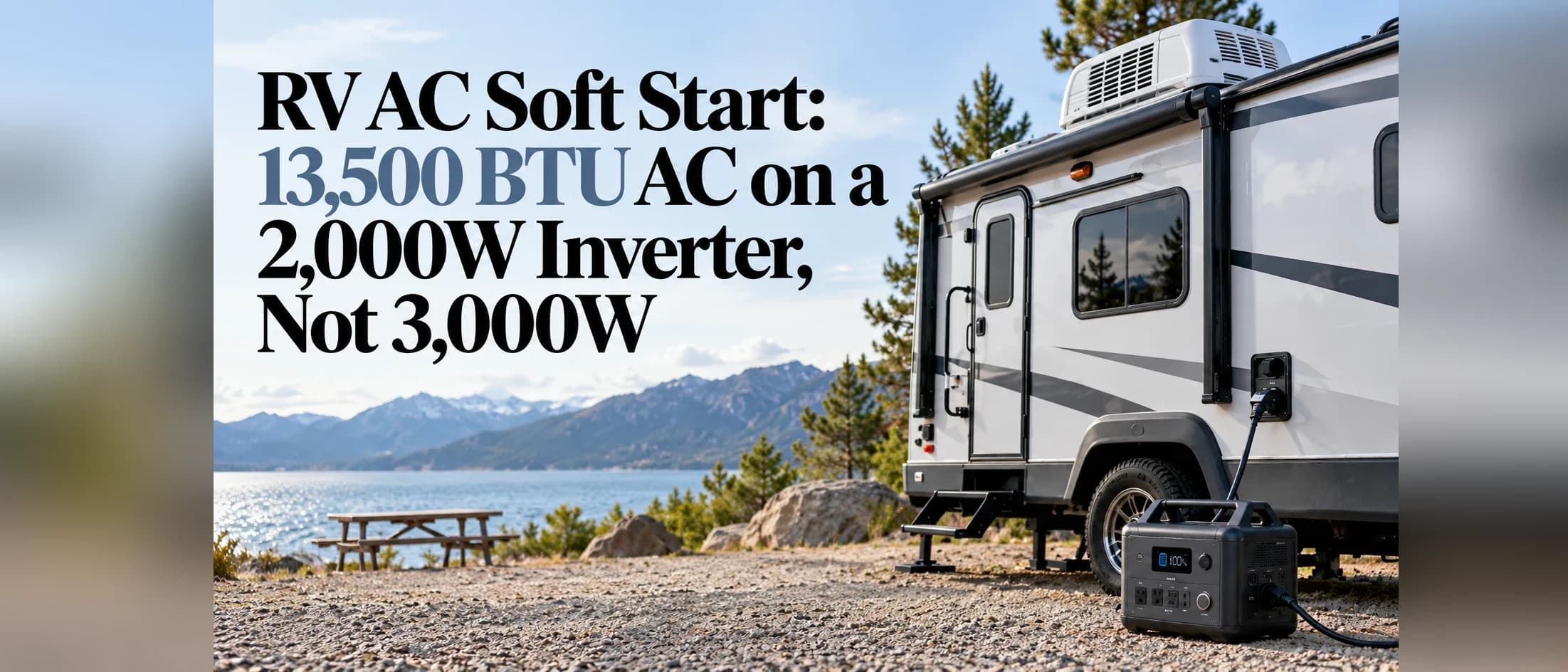
RV AC Soft Start: Run a 13,500 BTU AC on a 2,000W Inverter, Not 3,000W
The short answer: a soft start is a roughly $150-$310 module that cuts the startup surge of a rooftop RV air conditioner, so a 13,500 BTU unit that needs a 3,000W-plus inverter or generator can often start on one rated about 2,000-2,200W instead. It fixes the starting problem, not the running one: that same AC still draws about 1,300-1,600W while cooling, so a 2,000Wh power station runs it for only about 1.2 hours. Install one if your inverter or generator trips on startup; do not expect it to make all-night air conditioning on batteries practical.
Why a 13,500 BTU AC Is Hard on a Small Inverter
An air conditioner compressor draws a short spike when it starts, far above its running draw. Here are the numbers reported for a typical 13,500 BTU rooftop unit:
| Figure | Reported value | Source |
|---|---|---|
| Running power | 1,300-1,600W (about 12.5A at 120V) | RVACUnit |
| Startup surge seen by a generator or inverter | 2,800-3,000W; other sources say 3,000-5,000W | RVACUnit; Roam Wired |
| Locked-rotor amps (worst case at start) | 50-65A, depending on brand | RVACUnit |
| Minimum generator or inverter without a soft start | 3,000W | RVACUnit; Roam Wired |
The sources disagree on the real-world surge (2,800 to 5,000W), so treat 3,000W as a floor and not a promise. The locked-rotor current (50-65A, or 6,000-7,800VA at 120V) is the theoretical worst case; inverters and generators rarely see all of it, but it explains why a small unit can trip on startup.
What a Soft Start Does
A soft start sits between the supply and the compressor and ramps the motor up gradually instead of letting it draw full inrush current. Micro-Air, the best-known maker, says its EasyStart line delivers a 65-75% reduction in start-up current compared with the compressor's normal start amperage, supports compressors up to 18,000 BTU, and works with Dometic, Coleman-Mach, GE, and other brands and with pure or modified sine inverters (RV Upgrade Store listing). Applying that to a 50A start gives about 12-17A, which matches RVACUnit's example of roughly 50A falling to about 17A.
| Without a soft start | With a soft start | |
|---|---|---|
| Start current (example) | about 50A | about 17A |
| Start power at 120V | about 6,000VA locked-rotor worst case | about 2,000VA |
| Inverter or generator typically needed | 3,000W minimum | about 2,000-2,200W |
Micro-Air states that one 2,200W generator is enough to run a 3,000-15,000 BTU air conditioner with its EasyStart Breeze (Hutch Mountain listing). That is a manufacturer claim, and it is for a generator; we found no manufacturer test of a specific portable power station starting a 13,500 BTU AC.
The Part People Miss: Running Time
A 13,500 BTU AC that starts on a 2,000W inverter still uses about 1,500W while the compressor runs. Here is what that does to a power station, using independently measured usable energy where we have it:
| Power station | Measured or estimated usable energy | AC runtime at 1,500W |
|---|---|---|
| Bluetti Elite 200 V2 | 1.91kWh (StorageReview) | about 1.3 hours |
| Jackery Explorer 2000 Plus | 1,678Wh (OutdoorGearLab) | about 1.1 hours |
| Bluetti AC200L | about 1.74kWh (85% of rated) | about 1.2 hours |
| EcoFlow DELTA Pro 3 | 3.79kWh (OutdoorGearLab) | about 2.5 hours |
Cycling can stretch these numbers in mild weather, but in real heat the compressor runs most of the time. Roam Wired puts a 200Ah lithium bank at roughly 1.3 hours of cooling, and says all-night (8 hour) cooling takes about 1,200Ah of LiFePO4, which is $2,000-$4,000 in batteries alone. In our units, 8 hours at 1,500W is 12kWh, about three DELTA Pro 3 units. For hot-weather boondocking, a generator or a hookup is still the practical answer; a power station plus soft start suits short cooling runs and backup.
Which Power Stations Can Start It?
Check three things on the station: continuous output, whether it can briefly exceed it (surge or peak rating), and whether it has an RV outlet (TT-30).
| Station | Rated output | Notes |
|---|---|---|
| Bluetti AC200L | 2,400W (3,600W surge) | 30A RV outlet |
| Bluetti Elite 200 V2 | 2,600W | The 3,900W "Power Lifting" mode is for resistive loads, so don't count it for a compressor |
| Jackery Explorer 2000 Plus | 3,000W | Its 3,000W matches the 3,000W minimum cited for a stock 13,500 BTU AC, but the manufacturer does not guarantee it |
| EcoFlow DELTA Pro 3 | 4,000W (6,000W X-Boost) | Largest margin; 3.79kWh measured |
Station makers do not certify specific RV air conditioners, so check your AC's startup specs with the manufacturer, add a soft start if the station sits near the limit, and test on shore power first. See our best power station for RV living and mini split AC guide for related setups.
Cost and What to Look For
- Micro-Air EasyStart 364: listed at $299 on one retailer, though the product page notes it is no longer available and has been replaced.
- Micro-Air EasyStart Breeze: $308 on another retailer, with a 2-year warranty.
- Budget soft starters: Roam Wired quotes $150-$200 for retrofits such as SoftStartRV, so expect about $150-$310 in total.
Before buying, confirm compatibility with your compressor and BTU rating, whether the harness is plug-and-play for your AC brand, the return policy, and whether the maker publishes an installation manual.
Installation and Safety
This is work inside the AC's housing. Compressor run capacitors can hold a charge after power is off, so disconnect all power sources (shore, generator, inverter), follow the manufacturer's manual exactly for discharging and wiring, and mount the module in a dry spot away from the fan. Check the common, run, and start terminals against your unit's wiring diagram, and test on shore power before a generator or inverter. If you are not comfortable around capacitors and compressor wiring, a mobile RV technician is a reasonable expense. A weak run capacitor is a common cause of starting problems, so replace a marginal one before you blame the soft start.
Soft Start or a Bigger Power Source?
| Your problem | Best fix |
|---|---|
| The inverter or generator trips when the AC starts, but runs it fine once going | Soft start |
| It starts, but the battery empties in an hour | More battery capacity or a generator, not a soft start |
| Both, and you boondock in heat | Larger system, or a generator plus a soft start |
| Powered campsites only, with backup for outages | Usually neither: a mid-size station with a 30A RV outlet is enough for essentials |
Use our runtime calculator and wattage sizing guide to see which gap you are actually closing.
Disclosure: WattStation HQ may earn a commission if you purchase through links on this page, at no extra cost to you. This does not affect our rankings — see our editorial policy.
Frequently Asked Questions
Is an RV AC soft start worth it?
Yes if your generator or inverter trips on startup and you want to avoid buying a 3,000W-plus unit. It is not worth it if your problem is how long the battery lasts, because it does not reduce the running draw of about 1,300-1,600W.
Can a 2,000Wh power station run a 13,500 BTU RV air conditioner?
For about 1.2 hours of steady cooling, at 1,500W. A 2,000Wh-class unit can start it only if its output and surge rating are high enough, and a soft start helps. For longer runs you need much more capacity or a generator.
Hard start capacitor or soft start for an RV AC?
A hard start capacitor is mainly meant to help a struggling compressor start and is not marketed as a way to cut the surge. A soft start is built to reduce the surge itself, with Micro-Air quoting a 65-75% cut, so it suits running the AC from limited power sources.
Does a soft start harm the compressor?
Manufacturers design them to reduce start-up stress, and a correctly installed one should not harm it. Problems such as repeated failed starts usually trace to a weak capacitor or a wiring error. Check your AC maker's warranty terms before modifying a unit that is still under warranty.
Power Stations We'd Look At for This
Picked from our reviews for this scenario. Prices change often, so check the current price before you buy.
This page contains affiliate links. See our affiliate disclosure.
Bluetti AC200L
4.4/5 in our review
Bluetti Elite 200 V2
4.5/5 in our review
Jackery Explorer 2000 Plus
4.4/5 in our review
EcoFlow Delta Pro 3
4.4/5 in our reviewRelated Articles
 Use Cases
Can a Power Station Work as a UPS for Your Computer or Router?
Many power stations offer a UPS or EPS mode that switches to battery power during an outage. Here's how it actually works, and where it falls short of a dedicated UPS.
 Use Cases
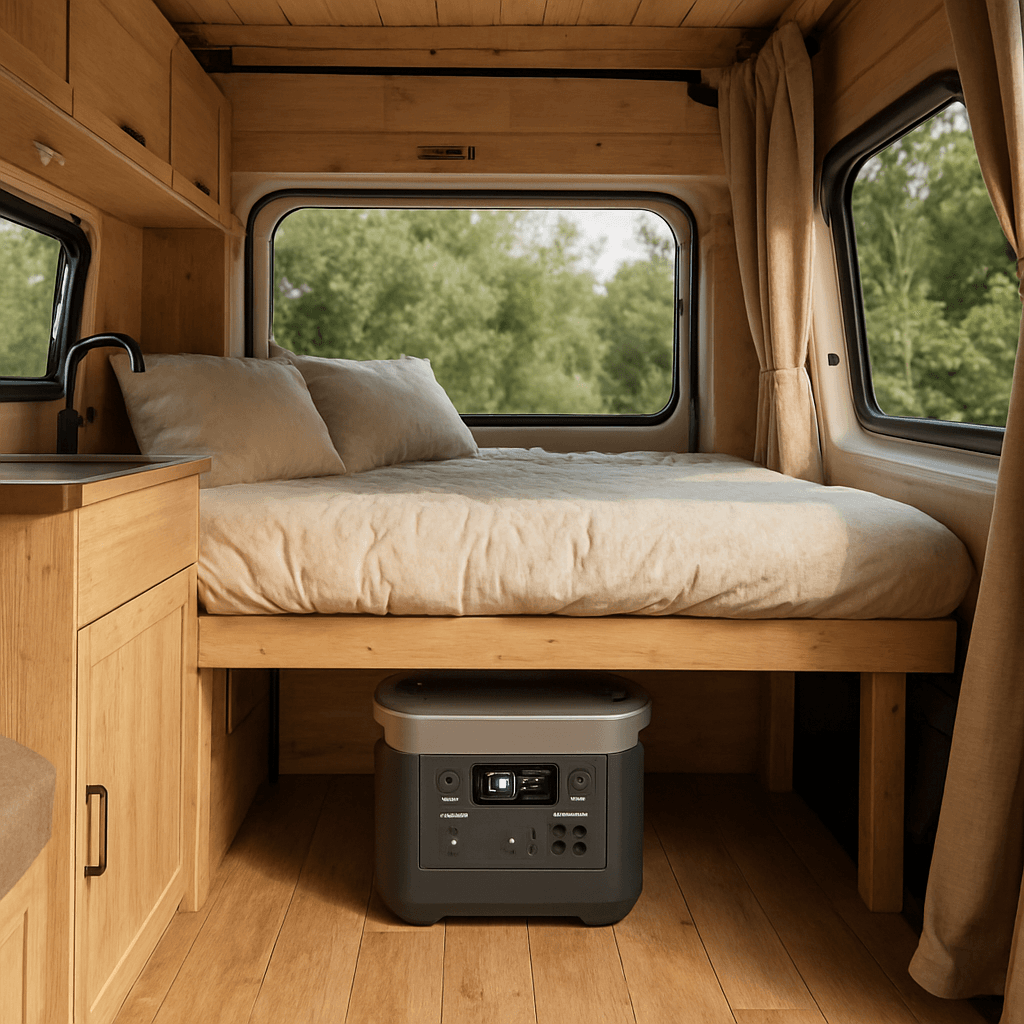
Portable Power Stations for Van Life: Complete Setup Guide
Everything you need to know to build a reliable power system for van life or full-time RV living, from sizing to solar to daily habits that make it last.
 Use Cases
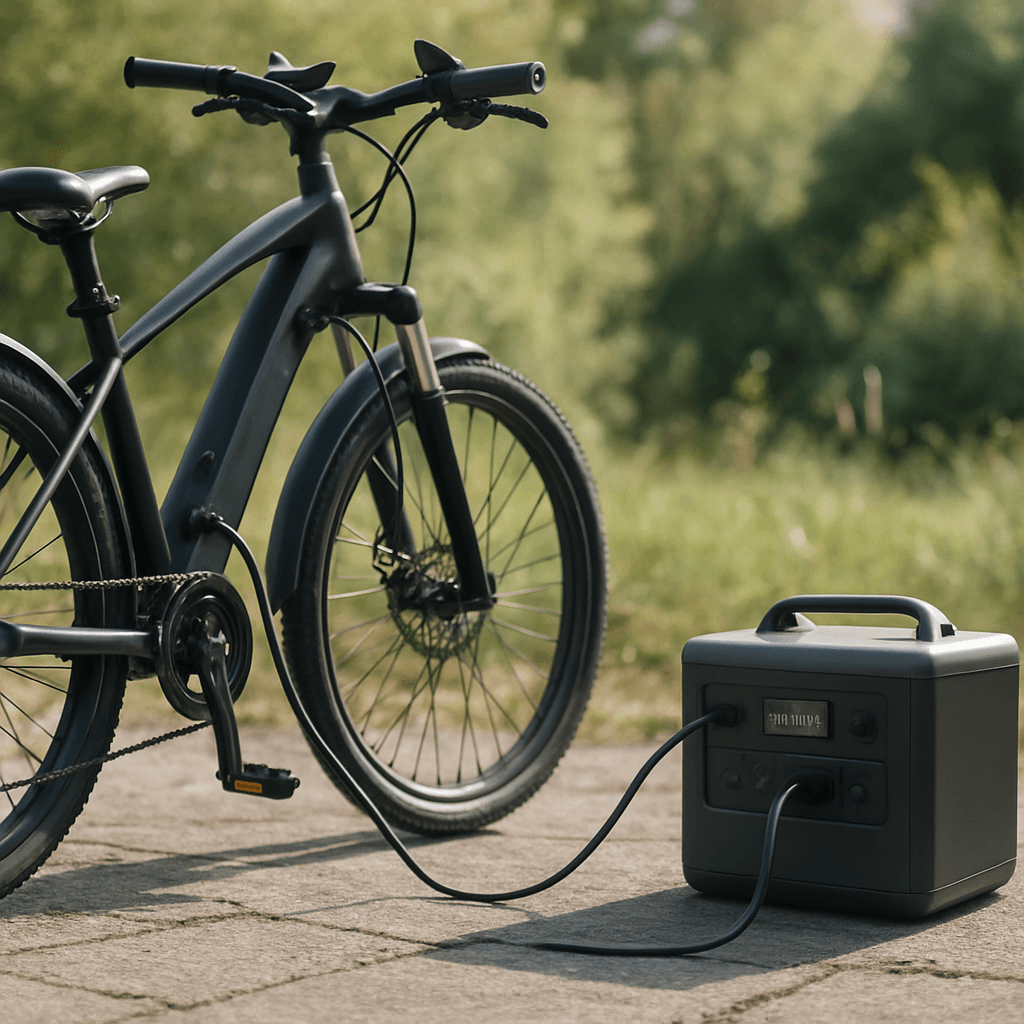
Using a Power Station to Charge an Electric Bike
E-bike charging away from home outlets is easier than you'd think with the right power station. Here's how to size one for your specific e-bike battery.