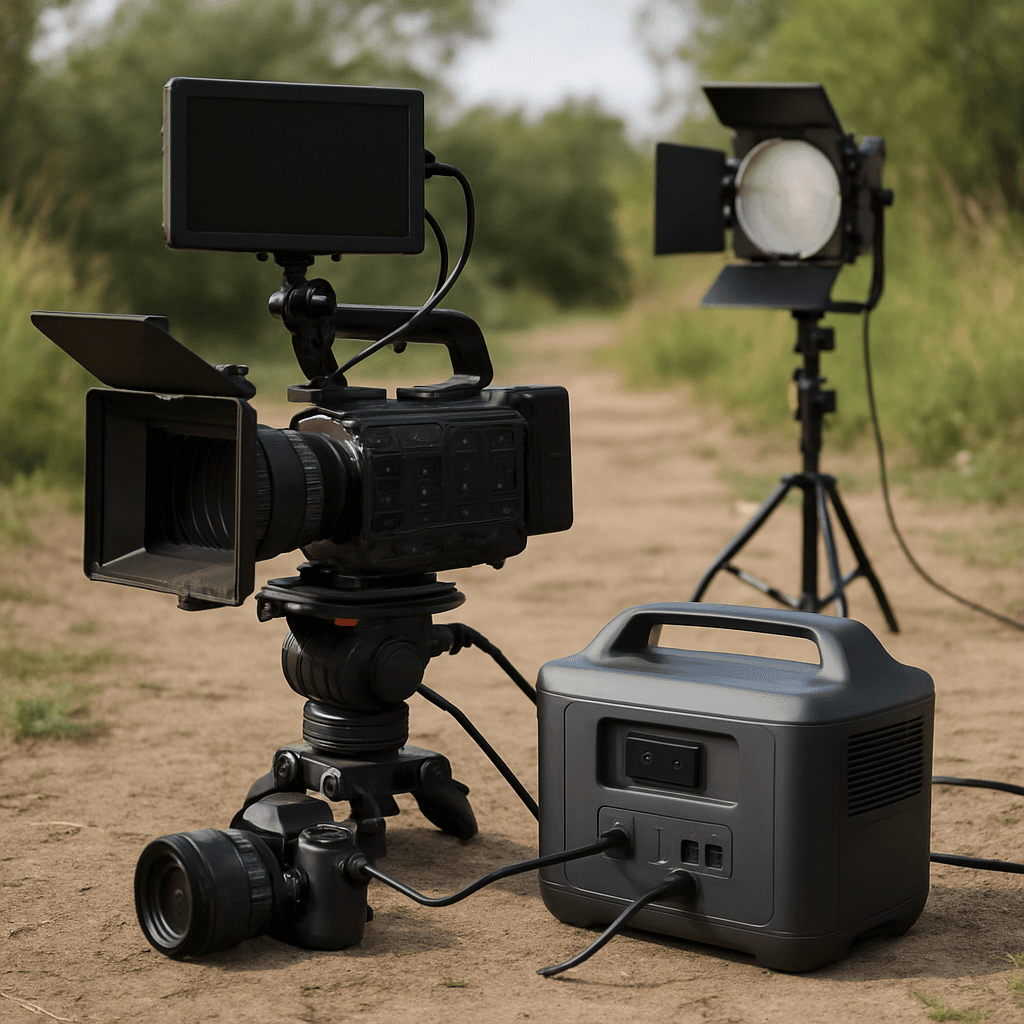
Power Stations for Photographers and Videographers on Location
For photographers and videographers shooting on location, a power station solves a real production problem: keeping camera batteries, lighting, and monitoring equipment running without generator noise bleeding into audio takes or a scramble to find outlets. Shooting a concert or festival specifically? See our power stations for music festivals guide for event-specific logistics.
Typical On-Location Equipment Load
| Equipment | Typical Watts |
|---|---|
| Camera battery charger | 20-60W |
| LED continuous lighting panel | 30-100W each |
| Laptop (tethering/review) | 65W |
| External monitor | 20-40W |
| Portable fan (talent comfort) | 20-40W |
A typical solo shoot (camera charging, laptop for tethering, one light panel) runs modest continuous wattage but benefits from a unit with fast recharge for multi-day shoots.
Why Silent Operation Matters Here
Unlike most use cases where noise is just an annoyance, for video production, generator noise can ruin audio takes entirely. A power station's silent operation is a genuine production advantage, not just a convenience — this is one of the clearest cases where battery power beats a gas generator outright regardless of runtime tradeoffs.
Recommended Units
For solo or small-crew shoots, a Jackery Explorer 1000 v2 covers camera charging, a laptop, and a light panel with room to spare, and its light weight matters for gear-heavy location shoots. For larger productions running multiple lights and monitors simultaneously, a EcoFlow Delta 2 Max provides more headroom.
Fast Charging Matters for Multi-Day Shoots
If you're shooting multiple consecutive days without returning to a studio or hotel, prioritize a fast-charging unit so you can top off overnight reliably — see our fast charging power stations guide for the quickest-charging options.
Protecting Sensitive Equipment
Cameras and monitors are sensitive electronics — confirm your power station outputs pure sine wave power (standard on nearly all mainstream LiFePO4 units) to avoid any risk to equipment, and avoid running near-capacity loads that could cause voltage fluctuations under heavy draw.
Weatherproofing for Outdoor Shoots
Location work often means shooting outdoors regardless of forecast, and camera gear is expensive enough that protecting the power station matters as much as protecting the lenses. Keep the unit under a canopy, in a case, or otherwise shielded from direct rain — most mainstream units aren't rated for more than light splash exposure, and a shoot that gets rained out is a much smaller problem than a fried power supply. See our weatherproofing guide for what specific IP ratings actually cover.
Building a Power Rotation for Multi-Day Productions
For shoots running several consecutive days without returning to a base, treat power the same way you'd treat camera batteries: have more capacity than you think you need, and build in a recharge buffer rather than running each unit down to empty before swapping. A common approach is one power station actively in use on set while a second charges at the hotel or production office, rotating daily — this avoids the single point of failure of relying on one unit's charge cycle to exactly match your shooting schedule.
Renting vs. Buying for Occasional Production Use
If on-location power needs come up only for occasional gigs rather than as a regular part of your workflow, buying a dedicated unit may not be the most efficient use of budget — see our guide to renting a power station for when renting per-project makes more financial sense than owning gear that sits unused between shoots.
Frequently Asked Questions
Can a power station charge camera batteries directly via USB?
Yes — most power stations include USB-A and USB-C outputs suitable for direct camera battery charger use, in addition to standard AC outlets for chargers that require them.
How much capacity do I need for a full day of shooting?
For a typical solo or small-crew shoot (camera charging, laptop, one to two lights), 500-1,000Wh comfortably covers a full shooting day; scale up for larger crews or multiple lighting setups running simultaneously.
Related Articles
 Use Cases
Can a Power Station Work as a UPS for Your Computer or Router?
Many power stations offer a UPS or EPS mode that switches to battery power during an outage. Here's how it actually works, and where it falls short of a dedicated UPS.
 Use Cases
Portable Power Stations for Van Life: Complete Setup Guide
Everything you need to know to build a reliable power system for van life or full-time RV living, from sizing to solar to daily habits that make it last.
 Use Cases
Using a Power Station to Charge an Electric Bike
E-bike charging away from home outlets is easier than you'd think with the right power station. Here's how to size one for your specific e-bike battery.