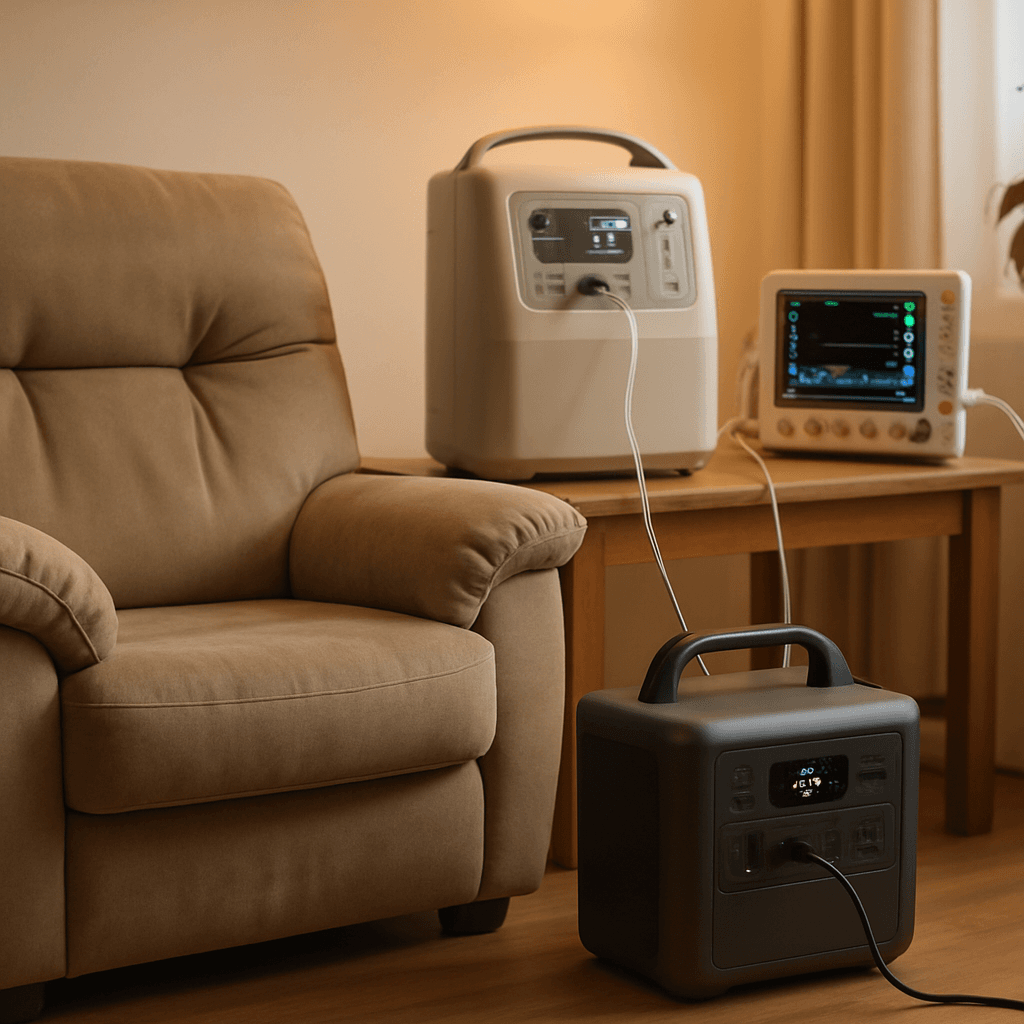
For households supporting elderly family members or anyone dependent on powered medical equipment, a power outage carries real health risk — not just inconvenience. Here's how to plan backup power appropriately for this specific need.
Common Medical Equipment and Power Draw
| Device | Typical Watts |
|---|---|
| CPAP machine (no humidifier) | 30-60W |
| CPAP machine (with humidifier) | 60-90W |
| Oxygen concentrator | 300-600W (varies significantly by model) |
| Electric wheelchair charger | 100-200W (while charging) |
| Nebulizer | 100-150W |
| Medical refrigeration (insulin, medications) | 50-100W average |
Oxygen concentrators in particular draw meaningfully more power than most other home medical devices and often have specific manufacturer guidance on backup power compatibility — always check your device's documentation and consult your medical equipment provider before relying on any power station for oxygen equipment specifically.
Sizing for Medical Reliability
Because the stakes are higher than general convenience backup, we recommend sizing with extra buffer for medical use — plan for at least 50% more capacity than your calculated daily need, and consider a unit with pass-through/UPS mode so equipment switches to battery automatically and instantly if grid power drops, without any gap in operation.
Recommended Units
For CPAP-only or moderate medical device needs, a Jackery Explorer 1000 v2 (1,070Wh) provides solid multi-night coverage with buffer. For households running an oxygen concentrator or multiple devices simultaneously, size up to a EcoFlow Delta 2 Max or larger, and always verify the specific device manufacturer's power requirements and any restrictions on battery-based power sources.
Talk to Your Medical Equipment Provider First
This is general guidance, not medical advice — before relying on any power station for critical medical equipment, confirm compatibility, wattage requirements, and any manufacturer restrictions directly with your durable medical equipment (DME) provider or the device manufacturer. Some medical devices have specific certification requirements for backup power sources.
Build a Complete Plan, Not Just a Power Station
For households with elderly or medically dependent family members, a backup power plan should also include a communication plan (how to reach help if needed), a way to monitor device battery/backup status, and, ideally, a secondary backup option in case the primary power station fails. See our 72-hour emergency power kit guide for the broader preparedness picture.
Fall Detection and Monitoring Devices Need Power Too
Beyond life-sustaining equipment, don't overlook smaller but genuinely important devices — medical alert pendants, fall-detection systems, and baby-monitor-style check-in cameras for an elderly family member typically draw very little power (often just a base station charging at a few watts), but a dead base station means the safety feature simply doesn't work when needed. Add these to your device inventory even though they seem minor; the wattage cost is negligible, but the consequence of forgetting them isn't.
Coordinating With Home Health Aides
If a home health aide or visiting nurse is part of your household's regular care routine, make sure they know where the power station is, how to operate it, and which devices take priority — during an actual outage, they may be the one managing equipment if family members aren't present. A brief walkthrough in advance, not during an emergency, ensures the plan actually works when it's someone other than the usual household member operating it.
Frequently Asked Questions
Can a power station run an oxygen concentrator safely?
Many oxygen concentrators can run on a power station with sufficient continuous output and pure sine wave power, but requirements vary significantly by model. Always confirm directly with your equipment manufacturer or DME provider before relying on any power station for oxygen equipment.
How much backup power buffer should I add for medical equipment specifically?
We recommend at least 50% more capacity than your calculated daily need for medical-equipment use cases, given the higher stakes of running out of power compared to general convenience backup.
Related Articles
 Use Cases
Can a Power Station Work as a UPS for Your Computer or Router?
Many power stations offer a UPS or EPS mode that switches to battery power during an outage. Here's how it actually works, and where it falls short of a dedicated UPS.
 Use Cases
Portable Power Stations for Van Life: Complete Setup Guide
Everything you need to know to build a reliable power system for van life or full-time RV living, from sizing to solar to daily habits that make it last.
 Use Cases
Using a Power Station to Charge an Electric Bike
E-bike charging away from home outlets is easier than you'd think with the right power station. Here's how to size one for your specific e-bike battery.