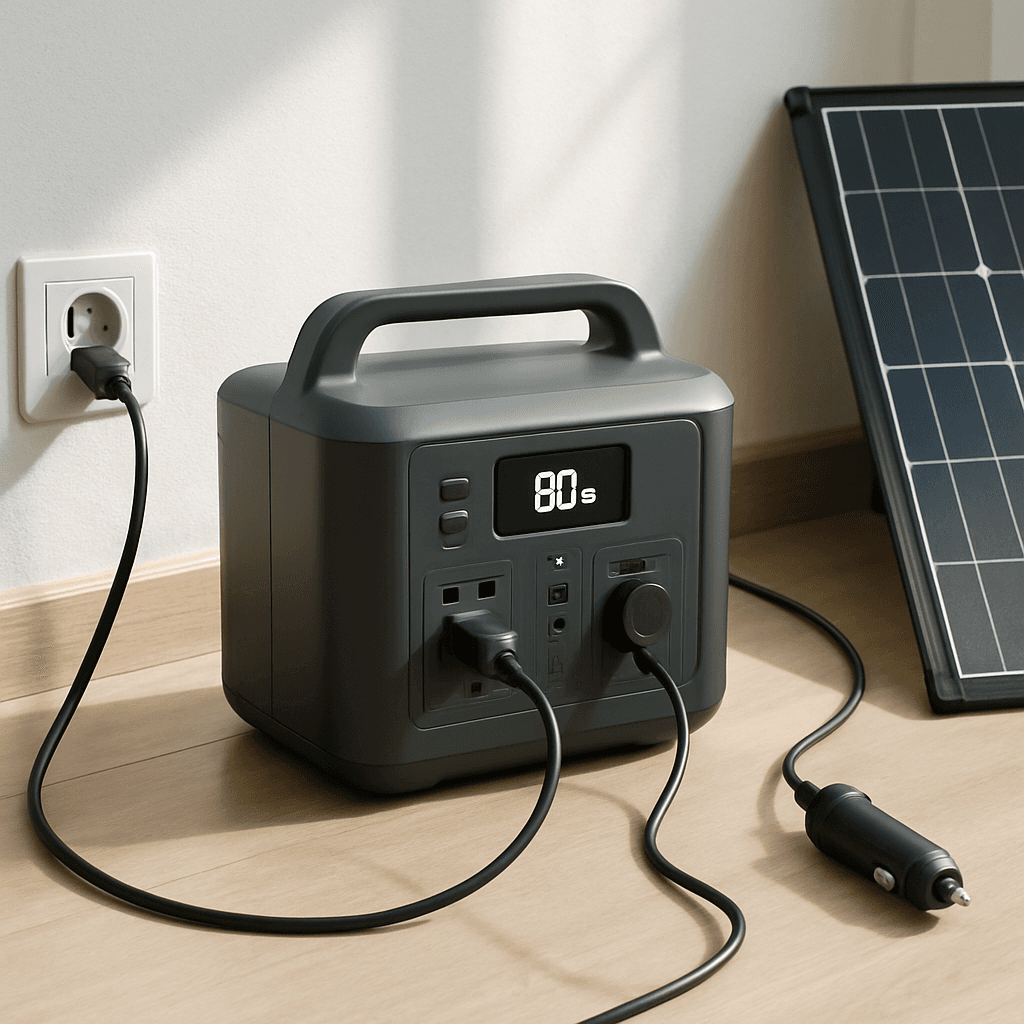
Power Station Charging Times Compared: AC vs Solar vs Car
Most power stations support three charging methods — AC (wall outlet), solar, and car/DC charging — each with real tradeoffs depending on your situation. Here's how they compare.
Speed Comparison
| Method | Typical Speed | Best Use Case |
|---|---|---|
| AC (wall outlet) | Fastest — often 0-80% in 45 min to 1.5 hours on modern units | Home charging, generator charging during outages |
| Solar | Slowest, weather-dependent — hours, varies significantly | Off-grid, extended outages, van life/camping |
| Car/DC | Moderate, limited by vehicle's output — several hours typical | Road trips, overlanding, driving between camps |
AC Charging: The Fast, Reliable Default
AC charging from a standard wall outlet or generator is almost always your fastest option, and modern fast-charging units like the EcoFlow Delta 2 Max (80% in 43 minutes) or Anker SOLIX F2000 (HyperFlash charging) have narrowed the gap even for large-capacity units. See our fast charging power stations guide for the quickest options.
Solar Charging: Slowest but Sustainable
Solar charging trades speed for sustainability — it's your only truly renewable, infinite recharge method, critical for extended off-grid use or multi-day outages without generator access. See our solar recharge time calculation guide for how to estimate realistic charging duration based on your specific panel setup.
Car/DC Charging: The Road Trip Option
Charging via your vehicle's 12V outlet or alternator is meaningfully slower than AC but works well as a supplemental charging method while driving between destinations — particularly relevant for overlanding and road trip use cases where you're driving substantial hours between stops anyway.
Dual-Input Charging: The Best of Both Worlds
Some units, like the Bluetti AC200L, support simultaneous AC and solar charging, combining both input sources for faster overall recharge when both are available — genuinely useful during an extended outage with intermittent generator access and available sunlight.
Choosing Your Primary Method
For home backup, AC charging (via generator if grid power is down) should be your primary plan, with solar as a valuable backup for extended outages. For camping, van life, or off-grid use, solar becomes your primary method by necessity, supplemented by AC charging whenever you have access to it.
Generator Charging Is Really Just AC Charging
If you're recharging from a portable or home standby generator during an outage, that's functionally the same as any other AC charging — your power station doesn't know or care whether the wall outlet it's plugged into is backed by the grid or a generator. The practical consideration is fuel logistics on the generator side, not charging speed, which stays consistent with the standard AC numbers above regardless of the electricity's ultimate source.
Why Charging Slows Down as It Approaches Full
Nearly every charging method (AC, solar, and car alike) slows down noticeably in the final 10-20% of a charge, a deliberate battery management behavior rather than a flaw — the charging circuitry tapers current near full capacity to protect long-term battery health. This is why manufacturer specs often quote "0-80%" times rather than "0-100%": the last stretch to full takes disproportionately longer, and budgeting around the 80% figure gives a more useful real-world planning number than assuming charging speed stays constant throughout.
Frequently Asked Questions
Can I charge my power station with all three methods at the same time?
Most units support only one or two simultaneous input methods (check your specific unit's spec) — dual AC+solar charging, like the Bluetti AC200L offers, is a specific feature not universal across all brands and models.
Is car charging bad for my vehicle's battery?
Charging a power station from your car's 12V outlet while the engine is running doesn't meaningfully draw down your vehicle battery, since the alternator is actively charging while driving. Avoid extended charging with the engine off, which can drain your vehicle's starter battery.
Related Articles
 Solar & Technical Guides
How Extreme Heat Affects Your Power Station (And What Desert Climates Need to Know)
Sustained heat above 113°F can cut a power station's usable lifespan roughly in half. Here's the real degradation math and what to actually do about it in hot climates.
 Solar & Technical Guides
Do Portable Power Stations Qualify for Tax Credits or Rebates?
Most portable power stations don't qualify for the federal battery tax credit — here's why, which setups actually might, and where state and utility rebates can still help.
 Solar & Technical Guides
How Much Does It Actually Cost to Run a Power Station vs. Grid Electricity?
A power station doesn't generate cheaper electricity — it stores grid or solar power for later. Here's the honest math on what that actually costs you per kWh.