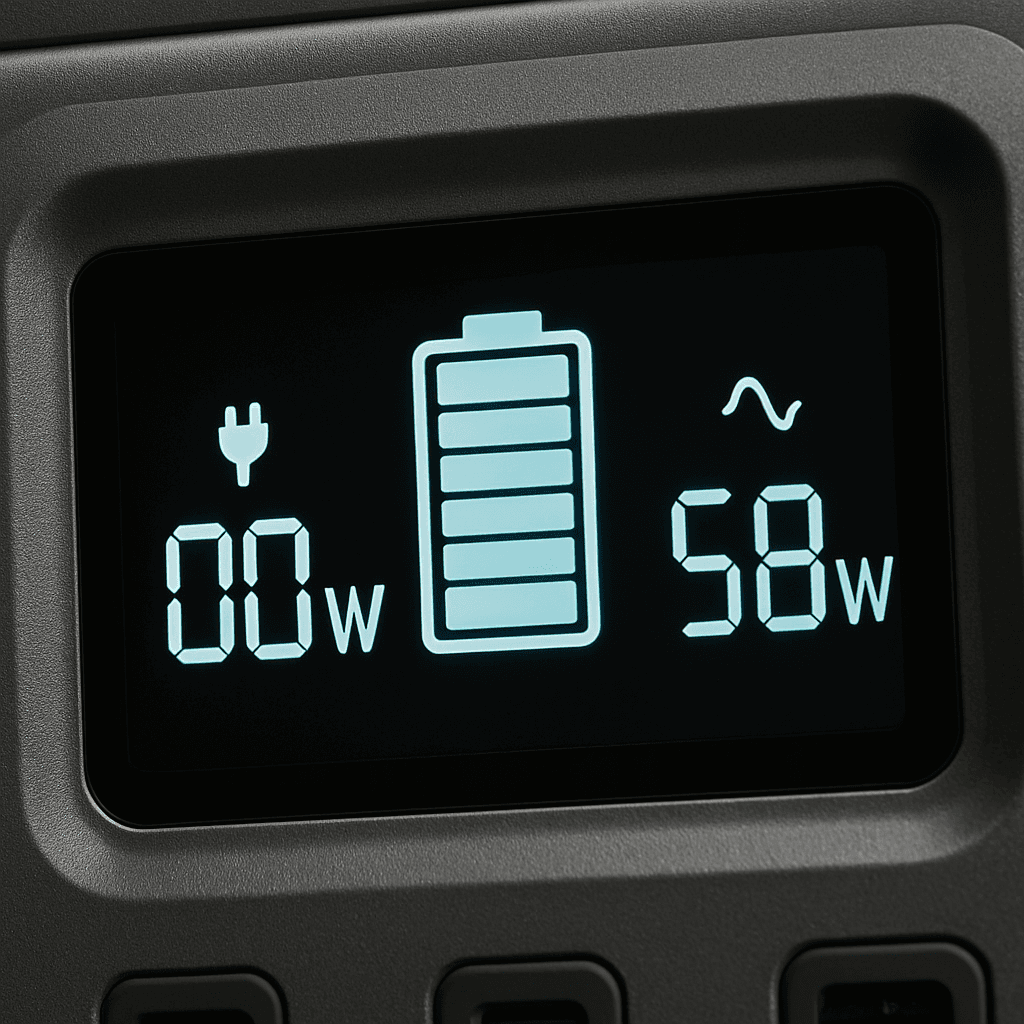
Understanding Watt-Hours vs Watts: A Beginner's Guide
A watt-hour (Wh) measures total stored energy; a watt (W) measures the rate power is delivered right now. If you've shopped for a portable power station for more than five minutes, you've run into these two units that look almost identical but mean very different things. Mixing them up is the number one reason people end up with a power station that can't actually do what they bought it for. Here's the plain-English breakdown.
What Is a Watt-Hour, Exactly?
A watt-hour is a unit of energy — the total amount of power delivered over time. One watt-hour equals 1 watt sustained for 1 hour, the same way "60 miles" describes a total distance regardless of whether you drove fast for a short time or slow for a long time. A power station's watt-hour rating (1,000Wh, 2,048Wh, and so on) is its total energy "tank size" — see the tank analogy below for how this plays out practically.
Watts vs. Watt-Hours: The Key Difference
| Watts (W) | Watt-Hours (Wh) | |
|---|---|---|
| What it measures | Power — the rate of energy use right now | Energy — the total amount stored or used |
| Answers the question | "Can this run at all?" | "For how long?" |
| Where you'll see it | Continuous output / surge rating | Battery capacity rating |
| Analogy | The width of a hose | The amount of water in the tank |
Watts: The Speed of Power
A watt is a unit of power — it measures the rate at which energy is being used or delivered at any given moment. When a power station is rated for "1,000W continuous output," that means it can deliver up to 1,000 watts of power at any instant, to any combination of devices plugged into it.
Every electrical device has a wattage rating (check the label or spec sheet). A laptop charger might draw 65W. A hair dryer might draw 1,500W. If the total wattage of everything you're running at once exceeds your power station's output rating, it will shut off or trip a breaker — regardless of how much energy is left in the battery.
Watt-Hours: The Size of the Tank
A watt-hour is a unit of energy — it measures how much total power is delivered over time. One watt-hour is exactly what it sounds like: 1 watt of power sustained for 1 hour. A power station rated at 1,000Wh has stored enough energy to run a 1,000W device for one hour, a 500W device for two hours, or a 10W device for 100 hours.
This is the number that answers "how long will it last?" — and it's the spec you should focus on when estimating runtime during a power outage or multi-day camping trip.
The Analogy That Makes It Click
Picture a garden hose filling a bucket:
- Watts = how wide the hose is (how fast water can flow out at any instant)
- Watt-hours = how much water is in the bucket (the total supply available)
A wide hose (high wattage output) lets you fill a large bucket quickly or run powerful tools — but if the bucket itself is small (low watt-hours), you'll run out fast no matter how wide the hose is. You need both numbers to understand what a power station can actually do for you. Our full wattage sizing guide walks through calculating both for your specific needs.
A Real Example
Take the Jackery Explorer 1000 v2, rated at 1,070Wh capacity with 1,500W continuous output:
- It can run a 1,200W appliance briefly, since that's under its 1,500W output ceiling.
- It cannot run that same 1,200W appliance for more than about 53 minutes (1,070Wh ÷ 1,200W ≈ 0.89 hours), because that's all the stored energy allows.
- It could run a 60W laptop for roughly 17–18 hours, since the load is small relative to the stored capacity.
Common Mistakes to Avoid
- Assuming a "2000" in the product name means 2000Wh. Some brands name products after wattage output, others after watt-hour capacity — always check both specs individually, never assume from the name.
- Ignoring surge/peak wattage. Motors (fridges, pumps, AC units) need a brief surge above their running wattage to start. A power station can meet the running watts but still trip on startup if its surge rating is too low.
- Forgetting inverter efficiency losses. Real-world usable watt-hours run roughly 85–90% of the rated capacity, due to inverter conversion losses — build in a small buffer when calculating runtime.
How to Convert Between Watts and Watt-Hours
The two units convert through time, not directly into each other — you always need a duration to bridge them:
Watt-hours = Watts × Hours. A 100W device run for 5 hours uses 500Wh. Watts = Watt-hours ÷ Hours. If a 1,000Wh battery is fully drained in 4 hours, the average draw was 250W.
There's no way to convert "watts" straight into "watt-hours" without a time component — they're not the same kind of unit, similar to how you can't convert "miles per hour" directly into "miles" without knowing how long you drove.
Frequently Asked Questions
Which number matters more, watts or watt-hours?
Neither matters more — they answer different questions. Watts tells you whether a device will run at all; watt-hours tells you for how long. You need to check both against your intended use.
What is a watt-hour in simple terms?
It's a unit of stored or used energy — literally "1 watt of power for 1 hour." A power station rated at 1,000Wh has enough stored energy to run a 1,000W device for one hour, a 500W device for two hours, or a 10W device for 100 hours.
Is a higher watt-hour number always better?
Not necessarily — more watt-hours means more runtime, but also more weight, size, and cost. The right number is whatever covers your actual planned devices and duration, per our wattage sizing guide, not simply the largest available.
How do I convert watt-hours to amp-hours?
Divide watt-hours by voltage. For a 12V battery system, 1,000Wh ÷ 12V ≈ 83Ah. This is mostly relevant if you're comparing a power station's internal battery to a traditional 12V deep-cycle battery. If you just need to convert a device's watts and amps (not watt-hours and amp-hours), our watts to amps calculator handles that directly.
Related Articles
 Solar & Technical Guides
How Extreme Heat Affects Your Power Station (And What Desert Climates Need to Know)
Sustained heat above 113°F can cut a power station's usable lifespan roughly in half. Here's the real degradation math and what to actually do about it in hot climates.
 Solar & Technical Guides
Do Portable Power Stations Qualify for Tax Credits or Rebates?
Most portable power stations don't qualify for the federal battery tax credit — here's why, which setups actually might, and where state and utility rebates can still help.
 Solar & Technical Guides
How Much Does It Actually Cost to Run a Power Station vs. Grid Electricity?
A power station doesn't generate cheaper electricity — it stores grid or solar power for later. Here's the honest math on what that actually costs you per kWh.