Can an EMP Destroy Your Power Station? What the Science Actually Says
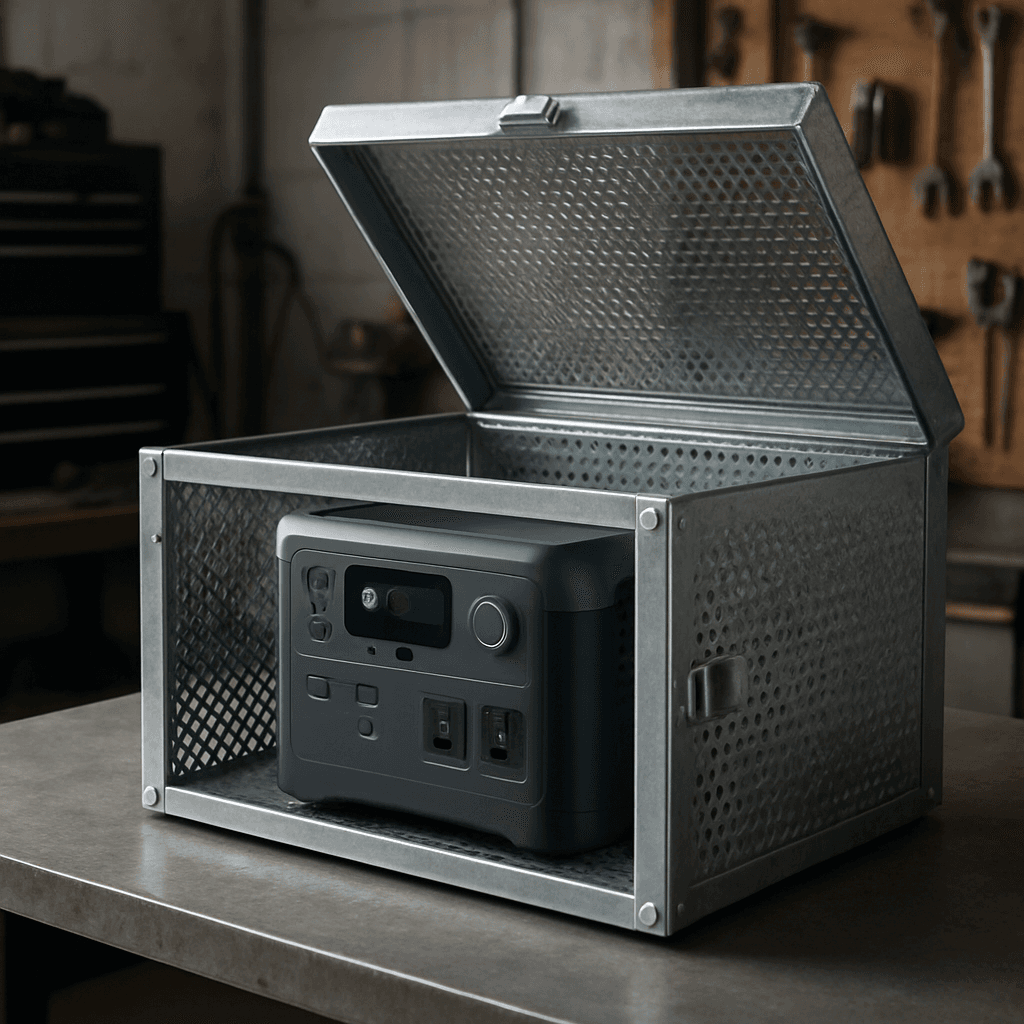
Partially, and it depends on which part of the unit you mean. The battery cells themselves are surprisingly EMP-resistant — the metal casing around most power stations already acts as a rough Faraday cage for the cells inside. The genuinely vulnerable part is the electronics: the battery management system, inverter, and charge controller chips that make the battery actually usable. A real Faraday cage protects the whole unit; relying on the casing alone is a gamble.
What an EMP Actually Is
An electromagnetic pulse is a burst of electromagnetic energy that can induce damaging voltage spikes in electronic circuits. There are two realistic sources worth distinguishing:
- A nuclear EMP (a high-altitude nuclear detonation) — the scenario most prepper content focuses on, and also the least likely for an ordinary household to ever experience.
- A geomagnetic event (a severe solar storm, like the 1859 Carrington Event) — a naturally occurring, scientifically documented phenomenon that has happened before and could happen again, generally considered the more realistic of the two risks, though still rare on a human timescale.
Neither is a high-probability event in any given year, and this article isn't trying to argue otherwise — but the underlying physics and protection methods are the same regardless of which scenario you're weighing, and they're genuinely interesting (and cheap to hedge against) either way.
Why Batteries Themselves Are Fairly EMP-Resistant
Most common battery types — including the LiFePO4 cells in modern power stations — hold up reasonably well against EMP exposure on their own. The metal housing surrounding the battery cells behaves somewhat like a Faraday cage already, directing electromagnetic energy around the outside rather than letting it reach the cells directly.
Why the Electronics Are the Real Weak Point
A power station is far more than its battery cells. The battery management system, the inverter that converts stored DC power to usable AC, and any smart charge controller circuitry are all sensitive electronics with the kind of small-scale conductive pathways that an EMP can overload. Even if the battery cells themselves survive intact, damaged control electronics can leave the whole unit non-functional — unable to charge, discharge, or communicate its charge state at all.
How a Faraday Cage Actually Works
A proper Faraday cage is a fully enclosed, conductive metal enclosure that intercepts electromagnetic energy at its outer surface and channels it around the contents rather than letting it penetrate inside. Key practical points:
- It must be fully enclosed — a cage with a gap, seam, or opening large relative to the wavelength involved can let energy leak through.
- The contents shouldn't touch the metal walls — direct contact can conduct energy into whatever's inside; use a non-conductive liner (cardboard, foam) between your gear and the cage's interior surface.
- Size matters less than completeness — a modest, fully sealed metal container offers real protection; a large, gappy one may not, regardless of how much thicker or more expensive the metal is.
Building or Buying Real Protection
You don't need a specialized bunker-grade enclosure for meaningful protection:
- A galvanized steel trash can with a tight-fitting lid, lined with cardboard inside, is a commonly used and genuinely functional DIY option.
- Purpose-built Faraday bags and boxes are sold specifically for EMP protection and are the simplest route if you'd rather not build one yourself — just confirm the product specifically claims Faraday-cage-level shielding, not just basic water resistance.
- A well-sealed metal ammo can works for smaller power stations and accessories, and doubles as generally rugged storage.
What to Actually Store in It
Given the practical size constraints of most home Faraday enclosures, most households don't try to shield their primary, daily-use power station — that would mean keeping it disconnected and inaccessible at all times, defeating its usefulness for the far more common threat (an ordinary grid outage). A more realistic approach: keep a smaller, dedicated backup unit — even an inexpensive one — stored in a Faraday container specifically as EMP insurance, while your main unit stays out and ready for everyday and routine emergency use.
Keeping Real Risk in Perspective
An EMP event affecting your specific household is a low-probability scenario compared to the outages this site otherwise focuses on — a storm, a grid failure, a heat wave. If you're already covering hurricane, winter storm, or general grid failure risk with a well-sized power station, that preparation already covers the overwhelming majority of real-world outage scenarios you're likely to face. EMP protection for a backup unit is a reasonable, inexpensive addition for people who want it — not something to prioritize over the basics.
Frequently Asked Questions
Does a microwave oven work as a makeshift Faraday cage?
A microwave's metal enclosure provides some shielding due to similar principles, but it's not a reliable substitute for a purpose-built Faraday container — the door seal and internal design aren't engineered for this use, and shielding effectiveness can vary. Use a dedicated Faraday bag, box, or lined metal container for anything you're specifically counting on.
Will an EMP definitely destroy an unprotected power station?
Not necessarily — outcomes depend on the EMP's specific intensity, the unit's distance from the source, and which internal components are affected. Some unprotected electronics survive real-world EMP events while others fail; Faraday protection removes the uncertainty rather than guaranteeing catastrophic failure without it.
Related Articles
 Emergency Preparedness
Winter Storm Power Outage Preparedness Guide (Texas Edition)
The 2021 Texas winter storm exposed how unprepared the grid can be for extreme cold. Here's how to plan backup power for Texas winter weather specifically.
 Emergency Preparedness
What to Do When the Power Goes Out: Step-by-Step Guide
The first 15 minutes after a power outage matter. Here's a clear, step-by-step guide for what to do the moment your power goes out.
 Emergency Preparedness
Preparing Your Home for a Multi-Day Power Outage
Multi-day outages require different planning than a brief interruption. Here's a complete household preparation checklist beyond just the power station.